
らしい / はず — Hearsay and Expectation
Learn らしい for hearsay/rumor and はずです for logical expectation based on known information. Distinguish from other inference expressions.
🎯 Goal: To accurately distinguish between and apply "らしい" and "はず" in speech and writing, enabling learners to express hearsay, intuitive conjectures, and logical expectations with natural N3-level fluency.
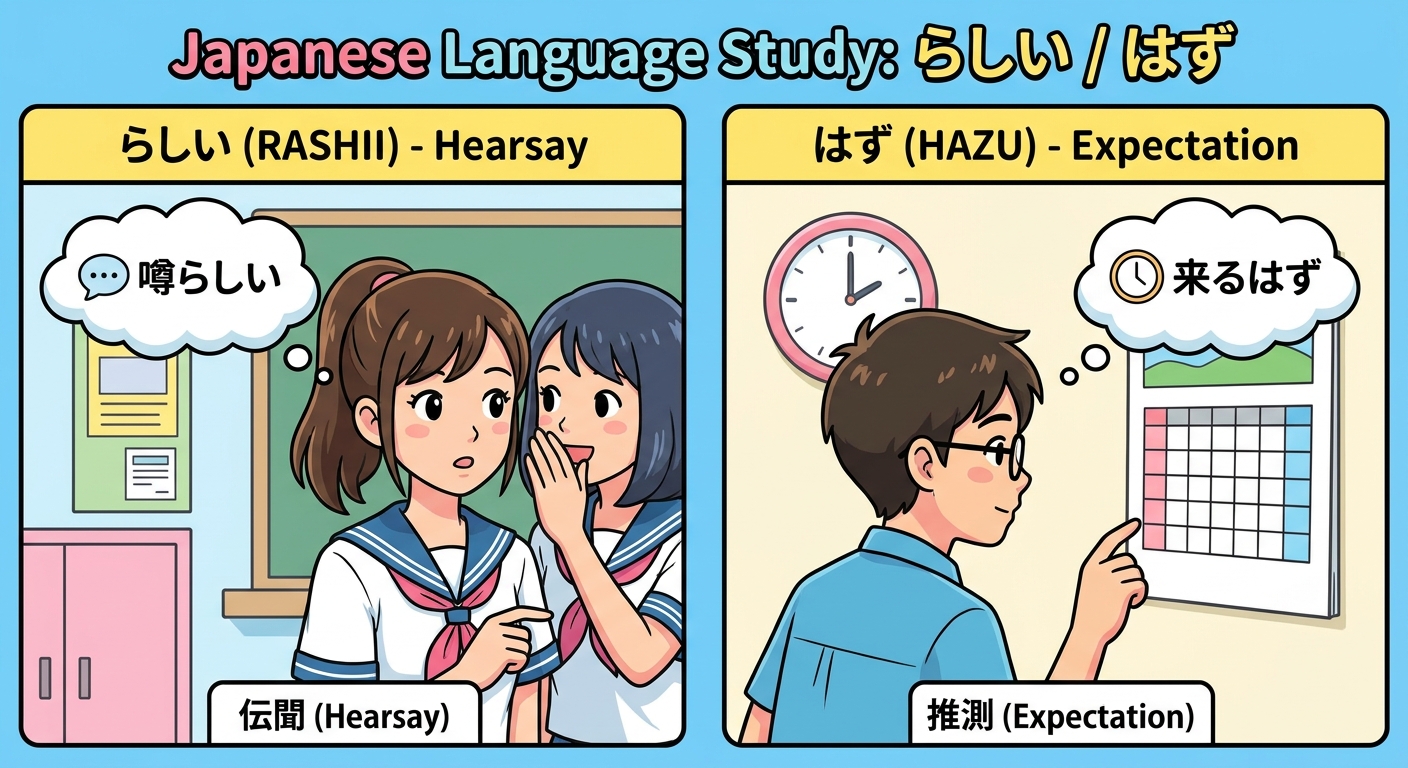
Introduction
Welcome to your N3 grammar lesson on "らしい" (rashii) and "はず" (hazu). As intermediate learners, moving beyond simple facts to express nuance, hearsay, and expectation is crucial for natural Japanese communication. In this lesson, we will explore how to use "らしい" to share information you have heard or to make intuitive conjectures based on external evidence. We will contrast this with "はず", which expresses a strong, logical expectation or certainty based on objective facts. Master these two essential grammar points to confidently discuss rumors, make deductions, and express what you believe should naturally happen in daily life.
Lesson Content
Master N3 Grammar: らしい vs はず (Hearsay vs. Expectation)
Welcome to your definitive guide to mastering らしい (rashii) and はず (hazu).
At the JLPT N3 level, expressing nuance is key. Both of these grammar points deal with assumptions, but they spring from entirely different sources: hearsay/conjecture vs. logical expectation.
Let’s break them down so you can use them flawlessly.
1. 〜らしい (Conjecture & Hearsay)
English equivalent: "It seems like...", "I heard that..."
Use らしい when you are making a guess based on information you heard, read, or observed indirectly. It carries a light, objective tone of "so I’ve heard."
How to Conjugate
| Part of Speech | Connection | Example |
|---|---|---|
| Verbs | Dictionary Form + らしい | 降る + らしい $\rightarrow$ 降るらしい |
| い-Adjectives | Dictionary Form + らしい | 美味しい + らしい $\rightarrow$ 美味しいらしい |
| な-Adjectives | Drop だ + らしい | 元気(だ) + らしい $\rightarrow$ 元気らしい |
| Nouns | Noun (no particle) + らしい | 雨 + らしい $\rightarrow$ 雨らしい |
Example in Action
天気予報によると、明日は雨が降るらしいです。
Tenki yohou ni yoru to, ashita wa ame ga furu rashii desu.
According to the weather forecast, it seems it will rain tomorrow.
(Nuance: I didn't see the rain clouds myself, but the forecast said so.)
2. 〜はず (Logical Expectation)
English equivalent: "Should be...", "Expected to..."
Use はず when you are making a strong, logical prediction based on facts, rules, or a schedule. You are saying, "Based on evidence, this is the only logical outcome."
How to Conjugate
| Part of Speech | Connection | Example |
|---|---|---|
| Verbs | Dictionary Form + はず | 来る + はず $\rightarrow$ 来るはず |
| い-Adjectives | Dictionary Form + はず | 寒い + はず $\rightarrow$ 寒いはず |
| な-Adjectives | Add な + はず | 簡単 + な + はず $\rightarrow$ 簡単なはず |
| Nouns | Add の + はず | 休み + の + はず $\rightarrow$ 休みのはず |
Example in Action
彼は毎日練習しているから、今日の試合に勝つはずだ。
Kare wa mainichi renshuu shite iru kara, kyou no shiai ni katsu hazu da.
Because he practices every day, he should win today's match.
(Nuance: Winning is the logical result of his hard work.)
The Ultimate Showdown: らしい vs. はず
To truly understand the difference, look at how the meaning changes in the same scenario:
Scenario: Tanaka-san's arrival tomorrow.
-
田中さんは明日来るらしい。
Tanaka-san wa ashita kuru rashii.- Meaning: "I heard Tanaka-san is coming tomorrow."
- Why: You heard a rumor or read an email, but you don't have official confirmation.
-
田中さんは明日来るはずだ。
Tanaka-san wa ashita kuru hazu da.- Meaning: "Tanaka-san is expected to come tomorrow."
- Why: You know his schedule, or he bought his plane ticket. It would be highly unusual if he didn't show up.
Quick Practice Challenge
Choose the correct particle/form to complete these sentences:
- 彼は昨日徹夜(てつや)したから、今は眠い (らしい / はずだ).
(Since he pulled an all-nighter yesterday, he must be sleepy now.) - あの店のラーメンは美味しい (らしい / はずだ)。SNSで話題になっている。
(I heard that shop's ramen is delicious. It's trending on social media.)
Answers
- はずだ (Logical expectation based on the fact that he didn't sleep).
- らしい (Hearsay based on social media buzz).
Exercises
らしい / はず — Hearsay and Expectation (Exercises)
Exercises for らしい / はず — Hearsay and Expectation
Review the grammar and vocabulary, and try to fill in the blanks or write sentences based on the prompts.
Practice Drills
Lesson Materials
Vocabulary (5)
Grammar (3)
Kanji (0)
No kanji characters in this lesson.
Kana (0)
No kana characters in this lesson.