
かぎり / だけあって — Limitation and Worthy Recognition
Express limits and conditions using かぎり (as long as / only if). Use だけあって for worthy recognition (as expected of). Use in formal professional contexts.
🎯 Goal: By the end of this lesson, you will be able to accurately use 〜かぎり to define conditional limits and 〜だけあって to express justified praise or high expectations based on a person's status, experience, or characteristics, aligning with JLPT N2 proficiency standards.
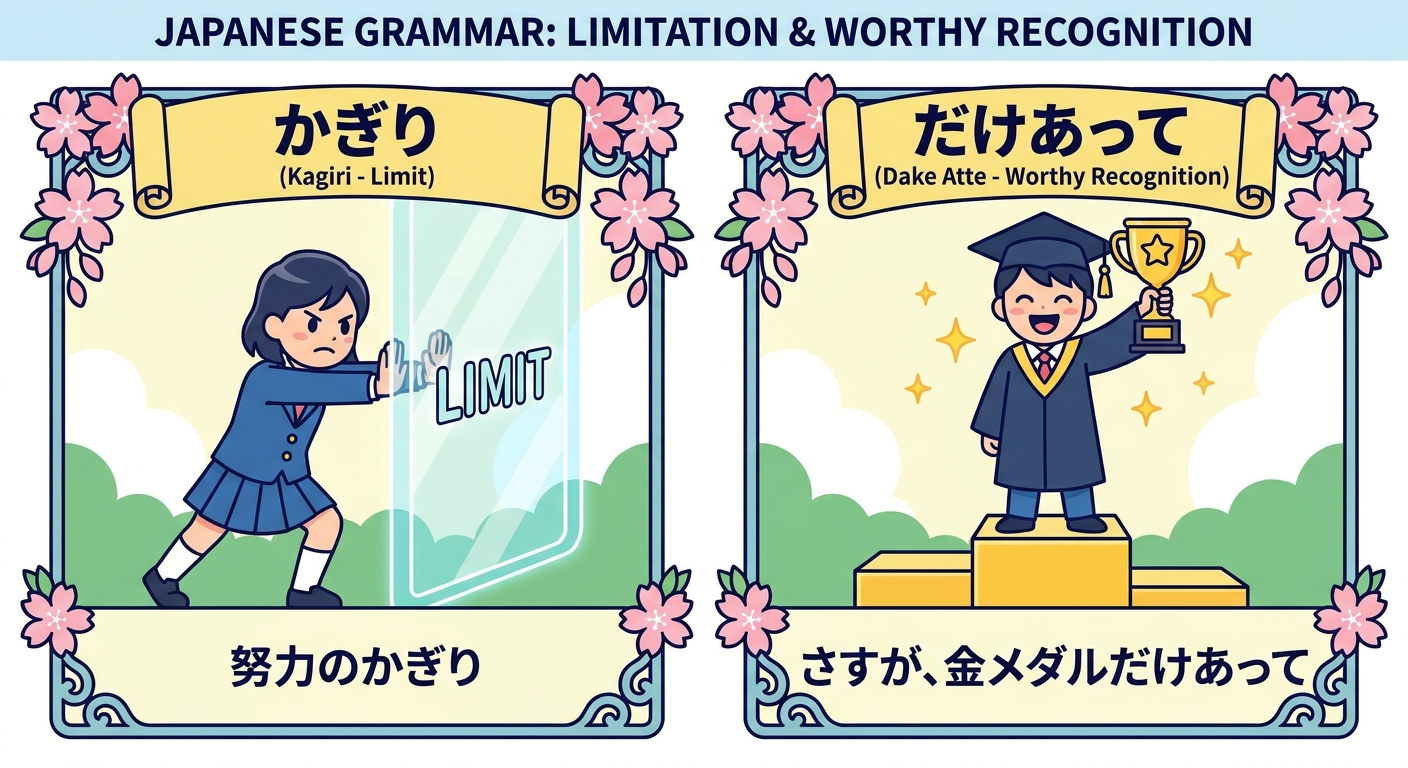
Introduction
Welcome to this JLPT N2 lesson focusing on two sophisticated grammar structures: 〜かぎり (kagiri) and 〜だけあって (dake atte). Mastering these expressions is key to achieving natural, upper-intermediate Japanese fluency. First, we will explore 〜かぎり, which establishes boundaries, meaning "as long as" or "to the extent of," allowing you to set precise conditions in your statements. Next, we will examine 〜だけあって, a structure used to praise or recognize someone's qualities, meaning "as expected of" or "precisely because." Together, these patterns will elevate your ability to express strict limitations and offer well-deserved recognition in both professional and daily contexts.
Lesson Content
Master JLPT N2: Limit Your Scope with 〜かぎり and Praise Excellence with 〜だけあって
Welcome, advanced learners! Today, we are mastering two essential JLPT N2 grammar patterns: 〜かぎり (kagiri) and 〜だけあって (dake atte).
While they serve completely different grammatical functions, both are crucial for expressing sophisticated relationships between conditions and outcomes. One draws a strict boundary line (limitation), while the other nods in deep respect to someone's status or effort (worthy recognition).
1. 〜かぎり (Kagiri) — "As long as..." / "To the limit of..."
The Core Concept
かぎり (derived from the kanji 限り, meaning "limit") sets a strict boundary. It asserts that as long as Condition A remains true, State B will continue unchanged. If Condition A changes, the deal is off.
Sentence Structure
| Word Class | Attachment Form | Example |
|---|---|---|
| Verb | Dictionary / ない-form + 限り | 働く限り (as long as I work) |
| Noun | N + である限り / Nの限り | 学生である限り (as long as one is a student) |
| い-Adjective | 〜い限り | 温かい限り (as long as it is warm) |
| な-Adjective | 〜な / 〜である限り | 元気な限り (as long as one is healthy) |
Contextual Examples
-
体に無理がない限り、毎日ジョギングを続けます。
- Romaji: Karada ni muri ga nai kagiri, mainichi jogingu o tsudukemasu.
- Translation: As long as it doesn't strain my body, I will continue jogging every day.
- Tutor's Insight: "無理がない" is the absolute condition. The moment it strains the body, the jogging stops.
-
私の知る限り、あの二人はただの友達です。
- Romaji: Watashi no shiru kagiri, ano futari wa tada no tomodachi desu.
- Translation: As far as I know, those two are just friends.
- Tutor's Insight: Here,
限りlimits the scope of the speaker's knowledge ("Within the boundary of my knowledge...").
2. 〜だけあって (Dake atte) — "As expected of..." / "Not indeed without reason..."
The Core Concept
This grammar point is used to show worthy recognition. It connects a highly regarded status, ability, or characteristic to an expected, positive result. It carries a strong nuance of admiration: "Because X is so great, it is only natural that Y is outstanding."
Sentence Structure
| Word Class | Attachment Form | Example |
|---|---|---|
| Verb | Plain Form + だけあって | 練習しただけあって (precisely because they practiced) |
| Noun | N + だけあって | プロだけあって (as expected of a professional) |
| い-Adjective | Plain Form + だけあって | 美味しいだけあって (as expected of something so delicious) |
| な-Adjective | 〜な + だけあって | 有名なだけあって (as expected of somewhere famous) |
Contextual Examples
-
彼はプロの翻訳家だけあって、言葉の選び方が素晴らしい。
- Romaji: Kare wa puro no hon'yaka dake atte, kotoba no erabikata ga subarashii.
- Translation: As expected of a professional translator, his choice of words is wonderful.
- Tutor's Insight: The speaker is admiring the translator's skill, linking the high quality directly to their professional status.
-
このカメラは高いだけあって、暗い場所でもきれいに撮れる。
- Romaji: Kono kamera wa takai dake atte, kurai basho demo kirei ni toreru.
- Translation: This camera is expensive for a reason; it takes beautiful photos even in dark places.
Tutor's Comparison & Pro-Tip
Do not confuse 〜だけあって (dake atte) with 〜だけに (dake ni).
- 〜だけあって is strictly used for positive praise and admiration. You cannot use it for negative outcomes.
- 〜だけに also means "precisely because," but it can be used for negative or unfortunate results (e.g., "Because I expected so much, I was deeply disappointed").
Quick Check:
- ⭕️ 彼は一流シェフだけあって、料理が美味しい。 (Positive: Perfect!)
- ❌ 彼は一流シェフだけあって、失敗した時の落ち込みが激しい。 (Negative outcome: Use だけに instead).
By mastering these two N2 structures, you can now set sophisticated conditions with 〜かぎり and deliver natural, elegant compliments with 〜だけあって. Keep practicing!
Exercises
かぎり / だけあって — Limitation and Worthy Recognition (Exercises)
Exercises for かぎり / だけあって — Limitation and Worthy Recognition
Review the grammar and vocabulary, and try to fill in the blanks or write sentences based on the prompts.
Examples
体力が続く限り、私はこの仕事を続けたいと思っています。
Tairyoku ga tsuzuku kagiri, watashi wa kono shigoto o tzuketai to omotte imasu.
As long as my physical strength lasts, I want to continue this work.
彼は一流のシェフだけあって、作る料理はどれも素晴らしい。
Kare wa ichiryū no shefu dake atte, tsukuru ryōri wa dore mo subarashii.
As expected of a first-class chef, every dish he makes is wonderful.
このマンションは駅から近いだけあって、やはり家賃が高い。
Kono manshon wa eki kara chikai dake atte, yahari yachin ga takai.
As is to be expected of an apartment close to the station, the rent is indeed high.
Practice Drills
Lesson Materials
Vocabulary (5)
Grammar (3)
Kanji (0)
No kanji characters in this lesson.
Kana (0)
No kana characters in this lesson.