
こそ / さえ / すら — Emphasis
Learn emphasis and extreme-example particles: こそ (precisely this), さえ (even), すら (even/as much as). Use in formal argument and essay writing.
🎯 Goal: By the end of this lesson, you will be able to distinguish between the subtle nuances of こそ, さえ, and すら, accurately apply them in both spoken and written contexts to convey precise emphasis, and correctly interpret their meanings in advanced Japanese texts.
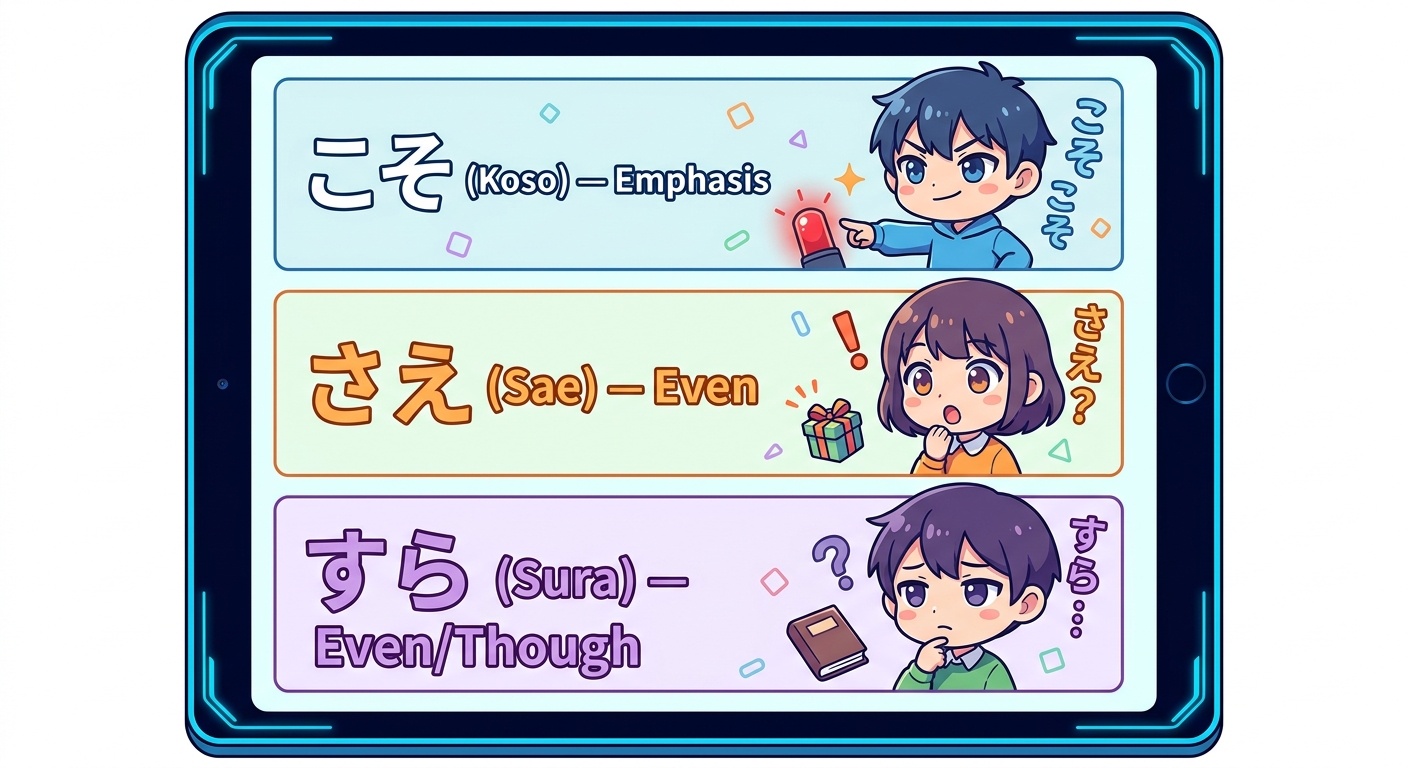
Introduction
Welcome to this N2 grammar lesson focusing on the nuanced world of emphasis particles: こそ, さえ, and すら. In advanced Japanese, expressing strong conviction, extreme cases, or unexpected conditions requires more than just basic particles. These three markers allow you to highlight specific elements of a sentence to convey deep emotion, contrast, or surprise. While they all serve to emphasize, they carry distinct nuances—こそ highlights a unique reason or subject, さえ denotes a minimum requirement or extreme example, and すら highlights an even more extreme, literary level of unexpectedness. Mastering these will elevate your expressive range and comprehension of authentic Japanese.
Lesson Content
Master N2 Particles: The Triad of Emphasis (こそ, さえ, すら)
In Japanese, when you want to elevate your speech from simple statements to nuanced, emotionally charged expressions, you use emphatic particles (toritate-joshi / 取り立て助詞).
Today, we will master three critical N2-level particles: こそ, さえ, and すら. While they all translate loosely to "indeed" or "even," they carry distinct grammatical rules and psychological nuances.
1. こそ (Koso) — "Precisely / For Sure"
こそ is used to single out one specific thing and strongly emphasize it, while implicitly or explicitly excluding everything else. It brings a positive, resolute, or appreciative tone to the sentence.
Key Grammatical Patterns
- Noun + こそ
- Verb-て + こそ (Only after doing [X] / Now that [X] has happened)
Examples & Nuances
- 今年こそ、N2に合格してみせる。
- Kotoshi koso, N2 ni gōkaku shite miseru.
- Translation: This year for sure, I will pass the N2.
- Nuance: It wasn't last year, and it won't be next year. This year is the absolute target.
- 親になってこそ、親の苦労がわかる。
- Oya ni natte koso, oya no kurō ga wakaru.
- Translation: Only after becoming a parent do you understand a parent's hardships.
- Nuance: Becoming a parent is the absolute prerequisite for this understanding.
2. さえ (Sae) — "Even" (The Extreme Minimum)
さえ indicates an extreme, baseline example to show that if this is the case, then everything else is naturally the same. It often replaces the subject/object particles (が/を).
Key Grammatical Patterns
- Noun (+ Particle) + さえ
- Verb-stem + さえ + する (Even do [X])
- Noun + さえ + Verb-ば (Conditional) (If only...) [Highly tested on N2!]
Examples & Nuances
- ひらがなさえ書けないなら、漢字は無理だ。
- Hiragana sae kakenai nara, kanji wa muri da.
- Translation: If you can't even write hiragana, kanji is impossible.
- Nuance: Hiragana is the absolute minimum requirement.
- お金さえあれば、幸せになれると思う。
- Okane sae areba, shiawase ni nareru to omou.
- Translation: If only I have money, I think I can be happy.
- Nuance: Money is the sole condition needed; nothing else matters.
3. すら (Sura) — "Even" (The Literary/Dramatic "Even")
すら is very similar to さえ, but with two major differences: it is highly literary (used in writing or formal speeches), and it usually emphasizes a negative or lamentable situation with a sense of surprise or disappointment.
Key Grammatical Patterns
- Noun (+ Particle) + すら
Examples & Nuances
- その事故のことは、親友にすら話していない。
- Sono jiko no koto wa, shin'yū ni sura hanashite inai.
- Translation: I haven't even told my best friend about that accident.
- Nuance: You would expect me to tell my best friend, so not telling them emphasizes the extreme secrecy/trauma.
- 病気が悪化して、立ち上がることすらできない。
- Byōki ga akka shite, tachiagaru koto sura dekinai.
- Translation: My illness worsened, and I cannot even stand up.
- Nuance: Standing up is a basic human function, making its impossibility shocking.
Quick Comparison Table
| Particle | Primary Meaning | Nuance / Tone | Key Structure to Remember |
|---|---|---|---|
| こそ | Precisely / For sure | Positive, resolute, appreciative | V-て + こそ (Only after...) |
| さえ | Even (minimum) | Objective limit, conditional | N + さえ + V-ば (If only...) |
| すら | Even (dramatic) | Literary, negative, surprising | N + すら (Usually negative outcome) |
Tutor's Challenge!
Can you spot the difference?
- あなたこそ、リーダーにふさわしい。 (You, and precisely you, are fit to be leader.)
- 子供でさえ知っている。 (Even a child knows it—it's that simple.)
- 名前すら忘れてしまった。 (I forgot even their name—how shocking/terrible.)
Exercises
こそ / さえ / すら — Emphasis (Exercises)
Exercises for こそ / さえ / すら — Emphasis
Review the grammar and vocabulary, and try to fill in the blanks or write sentences based on the prompts.
Examples
今年こそ、絶対に試験に合格してみせる。
Kotoshi koso, zettai ni shiken ni gōkaku shite miseru.
This year of all years, I will definitely show that I can pass the exam.
彼は忙しすぎて、食事をする時間さえなかった。
Kare wa isogashisugite, shokuji o suru jikan sae nakatta.
He was so busy that he didn't even have time to eat.
彼は怪我がひどくて、立ち上がることすらできなかった。
Kare wa kega ga hidokute, tachiagaru koto sura dekinakatta.
His injury was so severe that he couldn't even stand up.