
一方で / 反面 / ものの — Contrast
Express contrast and opposite outcomes: 一方で (on the other hand), 反面 (on the flip side), ものの (although). Use in opinion essays and formal discussion.
🎯 Goal: By the end of this lesson, you will be able to accurately distinguish between and employ 一方で, 反面, and ものの in written and spoken Japanese. You will confidently express dual perspectives, highlight opposing characteristics of a single situation, and make concessions in formal contexts, raising your discourse to a natural N2 level.
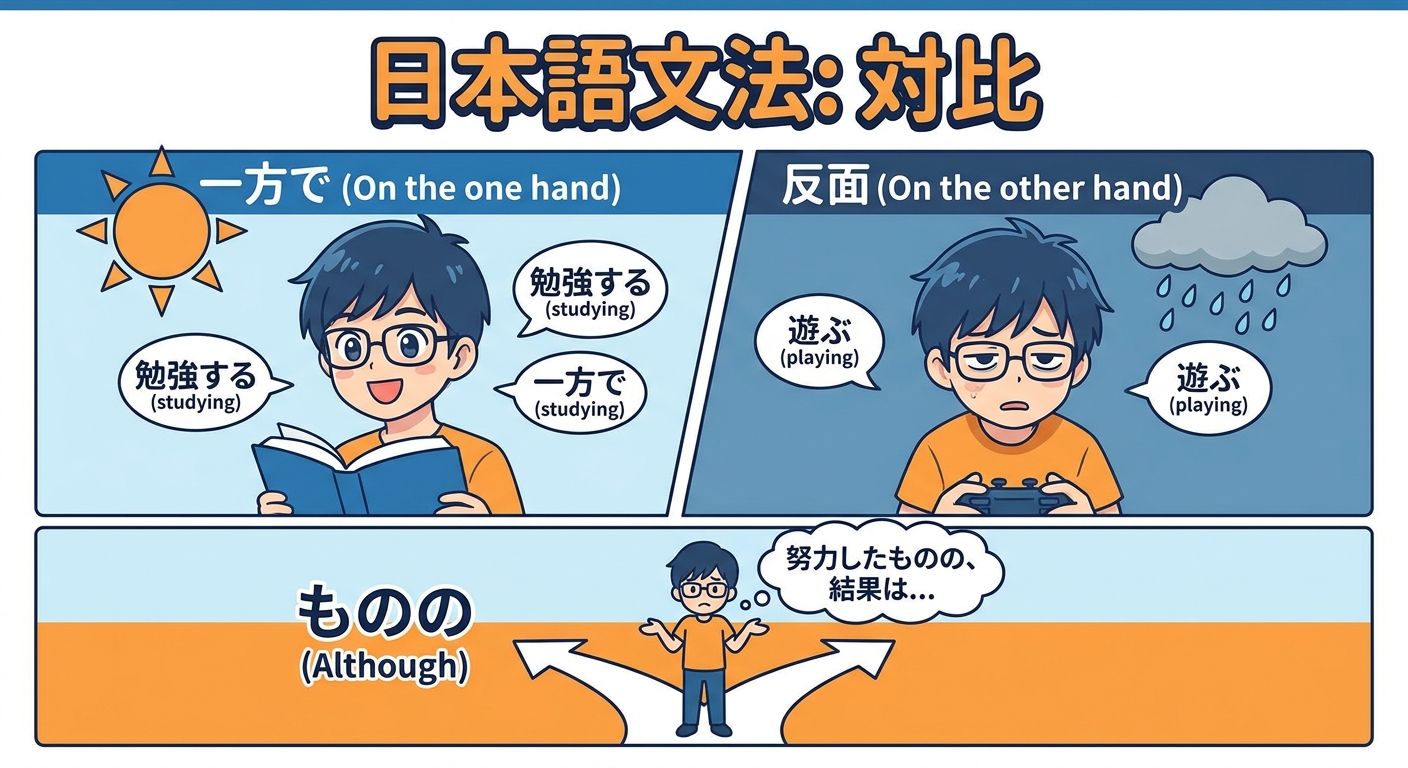
Introduction
Welcome to your N2 grammar lesson on advanced contrast markers: 一方で, 反面, and ものの. At the upper-intermediate level, expressing subtle nuances is key to sounding natural and sophisticated. While basic Japanese relies on simple connectives like けど or が, these three grammar points allow you to articulate complex, multi-faceted ideas. You will learn how to balance two coexisting perspectives with 一方で, highlight the dual, contradictory nature of a single subject using 反面, and concede a fact before introducing a contrasting reality with ものの. Mastering these will significantly elevate your essay writing and formal discussion skills.
Lesson Content
Master N2 Contrast: 一方で vs. 反面 vs. ものの
In intermediate-advanced Japanese, expressing contrast is no longer just about using が or けど. To achieve natural, N2-level fluency, you must learn to paint nuanced pictures of duality, contradiction, and concession.
Today, we will master three essential contrast markers: 一方で, 反面, and ものの.
1. 一方で (いっぽうで) — The Dual-Perspective Balancer
English equivalent: "On one hand..., on the other hand..." / "While..."
一方で is used to present two contrasting aspects of a single situation, or two parallel actions happening simultaneously. It is highly objective and frequently used in essays and news reporting.
Connection Formulas
- Verb (Plain Form) + 一方で
- い-Adjective + 一方で
- な-Adjective + な / である + 一方で
- Noun + の / である + 一方で
Example
- 彼は情熱的な研究者である一方で、優れた指導者でもある。
- Kare wa jōnetsutekina kenkyūsha de aru ippō de, sugureta shidōsha de mo aru.
- Translation: While he is a passionate researcher, on the other hand, he is also an excellent mentor.
2. 反面 (はんめん) — The Polar Opposites
English equivalent: "On the contrary" / "But at the same time"
While 一方で can simply list two different parallel facts, 反面 is used when those two facts are in direct contradiction or represent a trade-off (e.g., pros vs. cons, light vs. shadow) of the same subject.
⚠️ Key Difference: You cannot use
反面to compare two different people or things. It must look at two opposing sides of the same entity.
Connection Formulas
- Verb (Plain Form) + 反面
- い-Adjective + 反面
- な-Adjective + な / である + 反面
- Noun + である + 反面
Example
- 一人暮らしは自由な反面、寂しさを感じることも多い。
- Hitorigurashi wa jiyūna hanmen, sabishisa o kanjiru koto mo ōi.
- Translation: While living alone offers freedom, on the flip side, you often feel lonely.
3. ものの — The Concessive "Although"
English equivalent: "Although..." / "Even though..."
ものの is a concessive particle used to connect a recognized fact in the first clause with an unexpected, disappointing, or contrary reality in the second clause. It carries a nuance of "I admit X is true, but..."
Connection Formulas
- Verb (Plain Form) + ものの
- い-Adjective + ものの
- な-Adjective + な / である + ものの
- Noun + である + ものの
Example
- 日本語の文法は理解できたものの、会話となるとなかなか言葉が出てこない。
- Nihongo no bunpō wa rikai dekita mono no, kaiwa to naru to nakanaka kotoba ga dete konai.
- Translation: Although I understood Japanese grammar, when it comes to conversation, the words just don't come out easily.
Quick Comparison Guide
| Grammar Point | Nuance | Can compare two different subjects? | Tone |
|---|---|---|---|
| 一方で | Neutral balance of two aspects or parallel actions. | Yes ("A is X, while B is Y.") | Objective / Formal |
| 反面 | Internal contradiction (pros/cons, light/dark). | No (Must be the same subject.) | Analytical |
| ものの | Concession ("X is true, but the result is disappointing/unexpected.") | No (Focuses on the gap between expectation and reality.) | Reflective / Written |
Practice Challenge
Choose the correct particle (一方で, 反面, or ものの) to complete the sentence:
- 新しいスマホは便利な( )、画面が割れやすいという欠点がある。
- 彼は仕事を頑張っている( )、家族との時間も大切にしている。
- 契約書に署名した( )、まだ少し不安が残っている。
Answers
- 反面 (Direct trade-off: convenience vs. fragility)
- 一方で (Balancing two positive parallel actions)
- ものの (Concession: "Although I signed, I am still anxious")
Exercises
一方で / 反面 / ものの — Contrast (Exercises)
Exercises for 一方で / 反面 / ものの — Contrast
Review the grammar and vocabulary, and try to fill in the blanks or write sentences based on the prompts.
Examples
ネットショッピングは便利な一方で、個人情報が漏洩する危険性もある。
Netto shoppingu wa benri na ippou de, kojin jouhou ga rouei suru kikensei mo aru.
While online shopping is convenient, on the other hand, there is also a risk of personal information leaks.
一人暮らしは自由で気楽な反面、寂しさを感じることもある。
Hitorigurashi wa jiyuu de kiraku na hanmen, sabishisa o kanjiru koto mo aru.
Living alone is free and comfortable, but on the other hand, you sometimes feel lonely.
新しいパソコンを買ったものの、使い方がよく分からなくて困っている。
Atarashii pasokon o katta monono, tsukaikata ga yoku wakaranakute komatte iru.
Although I bought a new computer, I am having trouble because I don't really know how to use it.
Practice Drills
Lesson Materials
Vocabulary (5)
Grammar (3)
Kanji (0)
No kanji characters in this lesson.
Kana (0)
No kana characters in this lesson.