
によって / に対して / について
Learn three formal relationship markers: によって (by means of / depending on), に対して (towards / in contrast with), について (about / regarding). Practice in formal writing and speech contexts.
🎯 Goal: To accurately distinguish and apply 'によって', 'に対して', and 'について' to express cause, contrast, target, and topic confidently in N2-level Japanese.
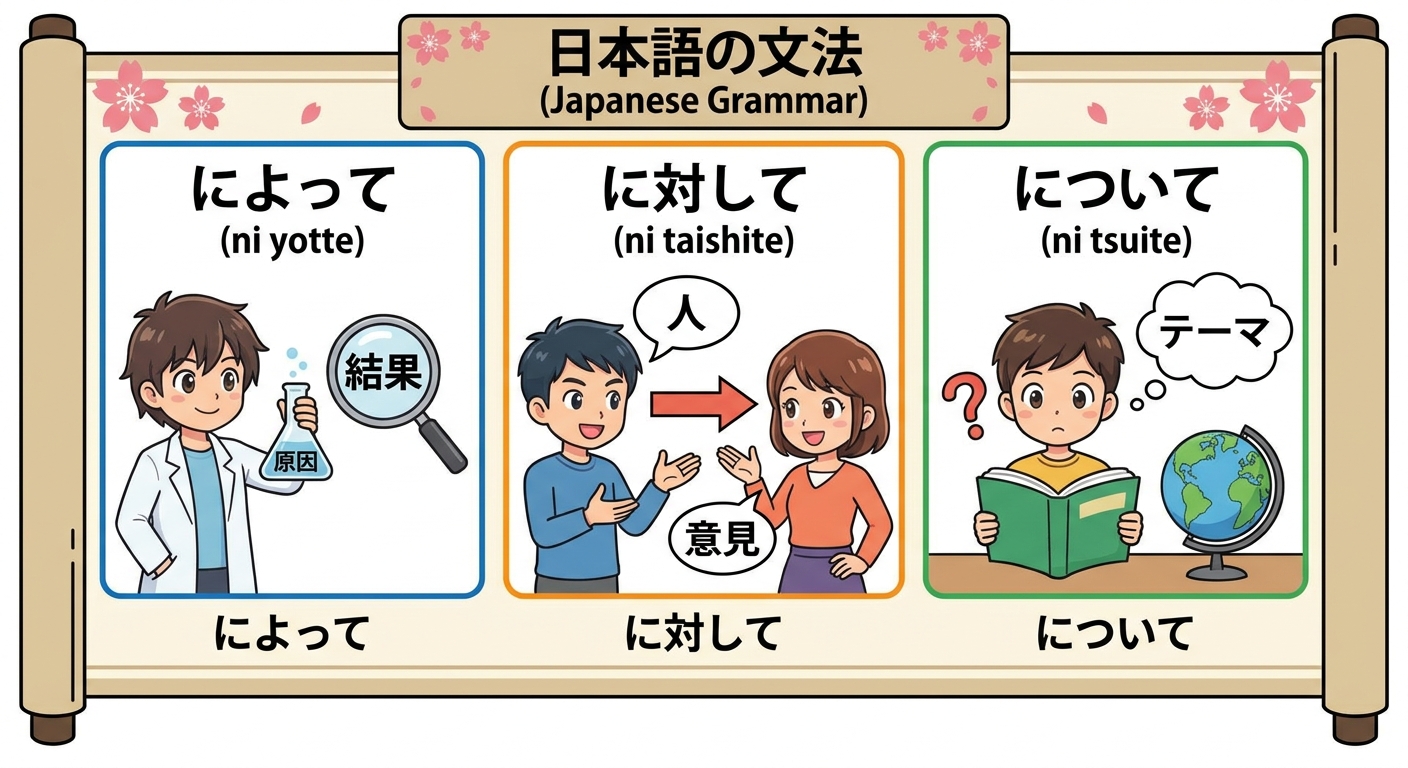
Introduction
Welcome to this N2 grammar lesson, where we demystify three essential compound particles that frequently appear in Japanese proficiency exams and formal communication: によって, に対して, and について. While they may seem structurally similar, each serves a distinct grammatical function. This lesson will clarify their various usages—ranging from expressing causes, methods, and agents with によって, to indicating targets or contrasts with に対して, and defining topics with について. By mastering these nuances, you will significantly enhance your reading comprehension and your ability to articulate complex relationships in both academic and professional Japanese.
Lesson Content
Master N2 Grammar: Demystifying によって, に対して, and について
Welcome to your JLPT N2 masterclass. Today, we are demystifying three of the most frequently tested—and easily confused—compound particles in Japanese: によって, に対して, and について.
While they all contain the particle に, their functions are vastly different. Let’s break down their nuances, structures, and real-world applications.
1. によって (Ni yotte) — *The Multi-Tool*
によって is one of the most versatile grammar points in Japanese. It has four distinct meanings depending on the context.
Connection:
- Noun + によって (Noun modifier form: 〜による + Noun)
The 4 Key Functions:
- The Passive Agent (By): Used in passive sentences to indicate the creator or instigator of an action.
- この小説は、夏目漱石によって書かれた。
- Kono shousetsu wa, Natsume Souseki ni yotte kakareta.
- This novel was written by Souseki Natsume.
- Cause & Reason (Due to / Because of): Indicates a cause that leads to a result (often negative or non-volitional).
- 台風によって、多くの家が被害を受けた。
- Taifu ni yotte, ooku no ie ga higai o uketa.
- Due to the typhoon, many houses suffered damage.
- Means & Method (Through / By means of):
- インターネットによって、世界中の人と繋がれる。
- Intaanetto ni yotte, sekaijuu no hito to tsunagareru.
- We can connect with people all over the world through the internet.
- Dependence & Variation (Depending on): Often paired with 違う (differ) or 変わる (change).
- 人によって、考え方が異なります。
- Hito ni yotte, kangaekata ga kotonarimasu.
- Ways of thinking differ depending on the person.
2. に対して (Ni taishite) — *The Target and Contrast*
に対して has two primary functions: directing an action/feeling toward a target, or contrasting two opposing things.
Connection:
- Noun + に対して (Noun modifier form: 〜に対する + Noun)
- Plain Form + のに対して (for contrast)
The 2 Key Functions:
- Target of Action or Attitude (Toward / To): Shows who or what an action, attitude, or feeling is directed at.
- お客さまに対して、丁寧な言葉を使いましょう。
- Okyakusama ni taishite, teinei na kotoba o tsukaimashou.
- Let's use polite language toward our customers.
- Contrast (While / In contrast to): Directly compares two contrasting elements.
- 兄が社交的なのに対して、弟は内向的だ。
- Ani ga shakouteki na no ni taishite, otouto wa naikouteki da.
- In contrast to his older brother being outgoing, the younger brother is introverted.
3. について (Ni tsuite) — *The Focused Spotlight*
について is used to introduce a topic of thought, speech, research, or writing. Think of it as placing a spotlight on your subject.
Connection:
- Noun + について (Noun modifier form: 〜についての + Noun)
Example:
- 日本の文化について研究しています。
- Nihon no bunka ni tsuite kenkyuu shite imasu.
- I am conducting research about Japanese culture.
💡 Elite Tutor Tip: Do not confuse について with に関して (ni kanshite). While both mean "about,"
に関してis more formal and covers a broader, indirect scope, whereasについてis more direct and specific.
Summary Comparison Table
| Grammar | Core Meaning | Noun Modifier Form | Example Context |
|---|---|---|---|
| によって | By (agent) / Due to / By means of / Depending on | 〜による | 台風による被害 (Damage due to the typhoon) |
| に対して | Toward (target) / In contrast to | 〜に対する | 先生に対する態度 (Attitude toward the teacher) |
| について | About / Regarding (topic) | 〜についての | 政治についての本 (A book about politics) |
Challenge Time!
Test your understanding by filling in the blanks with によって, に対して, or について.
- 私の大学のルールは、年々厳しくなっている。これ( __________ )、学生から不満の声が上がっている。
- 地震( __________ )、ビルが倒壊した。
- 新しいプロジェクト( __________ )、会議で話し合いましょう。
Answers:
- に対して (Toward this rule, students are expressing dissatisfaction.)
- によって (Due to the earthquake, the building collapsed.)
- について (Let's discuss in the meeting about the new project.)
Exercises
によって / に対して / について (Exercises)
Exercises for によって / に対して / について
Review the grammar and vocabulary, and try to fill in the blanks or write sentences based on the prompts.
Examples
国や文化によって、考え方が大きく異なります。
Kuni ya bunka ni yotte, kangaekata ga ookiku kotonarimasu.
Ways of thinking differ greatly depending on the country and culture.
お客様に対して、常に丁寧な言葉遣いを心がけています。
Okyakusama ni taishite, tsuneni teineina kotobazukai wo kokorogakete imasu.
I always make an effort to use polite language toward our customers.
この問題について、私たちは現在詳しく調査を行っています。
Kono mondai ni tsuite, watashitachi wa genzai kuwashiku chousa wo okonatte imasu.
Regarding this issue, we are currently conducting a detailed investigation.
Practice Drills
Lesson Materials
Vocabulary (5)
Grammar (3)
Kanji (0)
No kanji characters in this lesson.
Kana (0)
No kana characters in this lesson.