
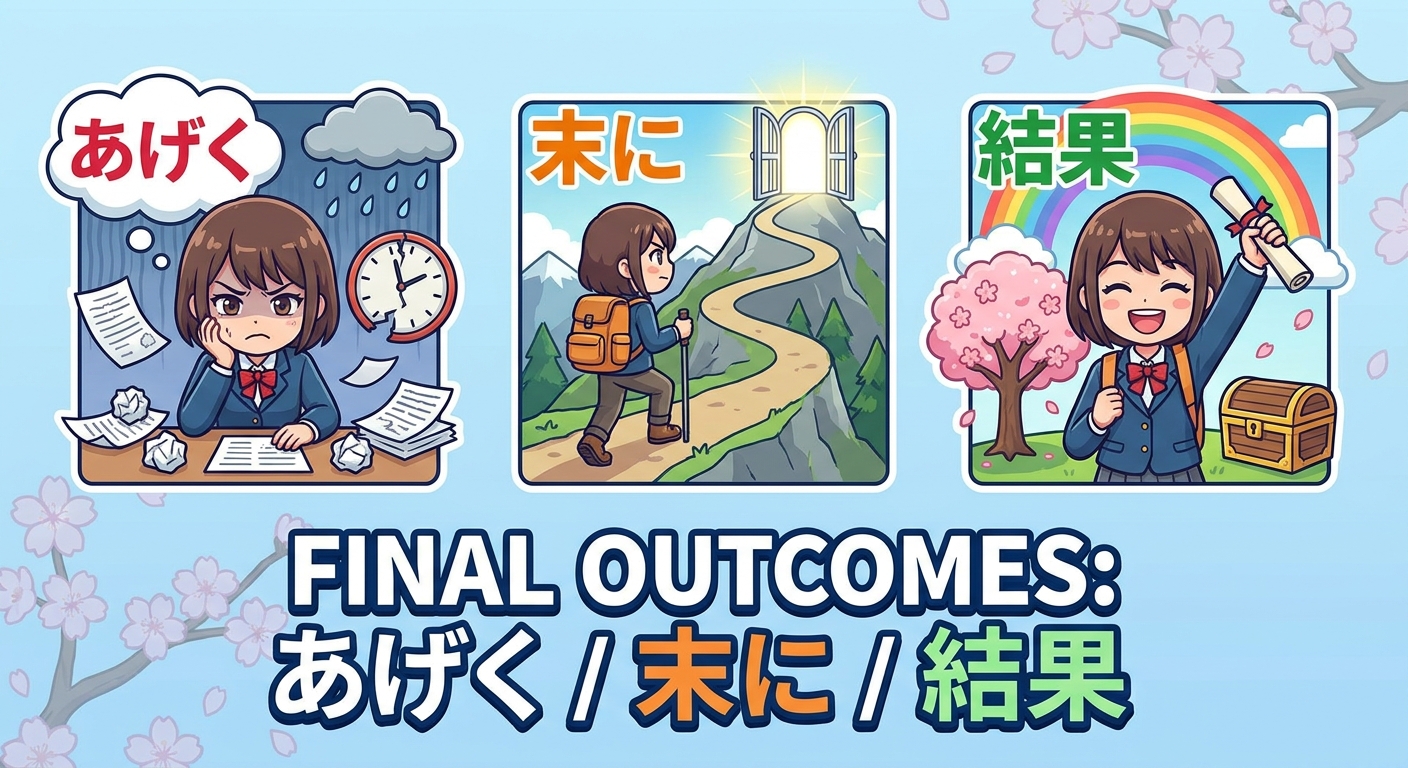
あげく / 末に / 結果 — Final Outcomes
Express final outcomes of long processes: あげく (after all that, negatively), 末に (finally after a long time), 結果 (as a result). Use in narratives and formal reports.
Lesson Content
Learning Goal
By the end of this lesson, you will be able to distinguish and correctly use three Japanese grammar patterns for expressing final outcomes: あげく (ageku), 末に (sue ni), and 結果 (kekka). You'll understand their subtle differences in nuance and formality.
Concept
In Japanese, when you want to say "after doing X, the final result was Y," you have three main options. While they all translate similarly to "as a result of" or "after," they carry different emotional weights:
- あげく → Negative, regretful outcome (often after a long struggle)
- 末に → Neutral or positive outcome (after careful thought/effort)
- 結果 → Objective, factual outcome (like a report)
Step-by-Step Breakdown
1. 〜あげく (ageku) — "After all that... (and it turned out badly)"
Meaning: After a long, difficult process, the final result was disappointing or regrettable.
Structure: Verb (た-form) + あげく / Noun + の + あげく
Nuance: Always carries a sense of frustration, wasted effort, or negative conclusion.
| Part | Japanese | Romaji | English |
|---|---|---|---|
| Verb example | 考えたあげく | kangaeta ageku | after thinking (and it was pointless) |
| Noun example | 葛藤のあげく | kattou no ageku | after the conflict (and it ended badly) |
Example sentences:
-
長い間迷ったあげく、結局何も買わなかった。
Nagai aida mayotta ageku, kekkyoku nani mo kawanakatta.
"After a long period of indecision, in the end I bought nothing." -
激しい議論のあげく、妥協案も出せずに終わった。
Hageshii giron no ageku, dakyouan mo dasezu ni owatta.
"After heated debate, it ended without even a compromise proposal."
2. 〜末に (sue ni) — "After careful... (and it turned out well or neutral)"
Meaning: After a period of effort, consideration, or struggle, the final result came (often positive or neutral).
Structure: Verb (た-form) + 末に / Noun + の + 末に
Nuance: Emphasizes the process and effort that led to the outcome. More formal than あげく.
| Part | Japanese | Romaji | English |
|---|---|---|---|
| Verb example | 熟考した末に | jukkou shita sue ni | after careful deliberation |
| Noun example | 話し合いの末に | hanashiai no sue ni | after discussion |
Example sentences:
-
熟考の末に、この会社を辞める決断をした。
Jukkou no sue ni, kono kaisha o yameru ketsudan o shita.
"After careful consideration, I made the decision to quit this company." -
長い交渉の末に、ようやく合意に達した。
Nagai koushou no sue ni, youyaku goui ni tasshita.
"After long negotiations, we finally reached an agreement."
3. 〜結果 (kekka) — "As a result... (factual, neutral)"
Meaning: Simply states the result or outcome. No emotion, just fact.
Structure: Verb (た-form) + 結果 / Noun + の + 結果
Nuance: Objective and report-like. Used in news, business, and academic writing.
| Part | Japanese | Romaji | English |
|---|---|---|---|
| Verb example | 調査した結果 | chousa shita kekka | as a result of the investigation |
| Noun example | 努力の結果 | doryoku no kekka | as a result of effort |
Example sentences:
-
検査した結果、異常は見つかりませんでした。
Kensa shita kekka, ijou wa mitsukarimasen deshita.
"As a result of the examination, no abnormalities were found." -
話し合いの結果、来月から新しいルールを導入することになった。
Hanashiai no kekka, raigetsu kara atarashii ruuru o dounyuu suru koto ni natta.
"As a result of the discussion, it was decided to introduce new rules from next month."
Mini Examples (Side-by-Side Comparison)
| Situation | あげく | 末に | 結果 |
|---|---|---|---|
| After a long argument | 喧嘩のあげく、別れた (kenka no ageku, wakareta) — They broke up (regretfully) | 話し合いの末に、別れた (hanashiai no sue ni, wakareta) — They broke up (after discussion) | 話し合いの結果、別れた (hanashiai no kekka, wakareta) — As a result of discussion, they broke up (fact) |
| After studying | 勉強したあげく、落ちた (benkyou shita ageku, ochita) — Studied but failed (wasted effort) | 勉強の末に、合格した (benkyou no sue ni, goukaku shita) — After studying, passed (effort paid off) | 勉強した結果、合格した (benkyou shita kekka, goukaku shita) — As a result of studying, passed (fact) |
Common Mistake
Mistake: Using あげく for positive outcomes.
❌ 努力のあげく、成功した。
Doryoku no ageku, seikou shita.
(This sounds like "after all that effort, I succeeded... but it was somehow regrettable" — unnatural.)
✅ 努力の末に、成功した。
Doryoku no sue ni, seikou shita.
"After much effort, I succeeded." (Natural — effort led to success)
✅ 努力の結果、成功した。
Doryoku no kekka, seikou shita.
"As a result of effort, I succeeded." (Natural — factual)
Rule of thumb: If the outcome is good, use 末に or 結果. Save あげく for when things went wrong or you regret the result.
Quick Practice
Fill in the blanks with あげく, 末に, or 結果 (in the correct form):
-
三日間考えた____、彼女にプロポーズすることにした。
Mikkakan kangaeta ______, kanojo ni puropoozu suru koto ni shita.
(After three days of thinking, I decided to propose to her.) -
無理なダイエットの____、体調を崩してしまった。
Muri na daietto no ______, taichou o kuzushite shimatta.
(After a reckless diet, I ruined my health.) -
実験の____、新しい物質が発見された。
Jikken no ______, atarashii busshitsu ga hakken sareta.
(As a result of the experiment, a new substance was discovered.)
Answers:
- 末に (sue ni) — positive/neutral decision after thought
- あげく (ageku) — negative outcome from the diet
- 結果 (kekka) — factual scientific result
Summary and Next Step
| Pattern | Nuance | Best for |
|---|---|---|
| あげく | Negative, regretful | Bad outcomes after struggle |
| 末に | Neutral/positive, effort-focused | Good outcomes after hard work |
| 結果 | Factual, objective | Reports, news, data |
Next step: Try writing three short sentences about your own experiences — one regretful (use あげく), one successful after effort (use 末に), and one factual observation (use 結果). Practice reading them aloud to internalize the rhythm and nuance.
Exercises
あげく / 末に / 結果 — Final Outcomes (Exercises)
Exercises for あげく / 末に / 結果 — Final Outcomes
Review the grammar and vocabulary, and try to fill in the blanks or write sentences based on the prompts.
Examples
何時間も悩んだあげく、結局何も買わずに店を出た。
Nanjikan mo nayanda ageku, kekkyoku nani mo kawazu ni mise o deta.
After worrying for hours, I ended up leaving the store without buying anything.
長時間の話し合いの末に、ようやく二人は和解することに合意した。
Chōjikan no hanashiai no sue ni, yōyaku futari wa wakai suru koto ni gōi shita.
After a long discussion, the two of them finally agreed to reconcile.
毎日の努力の結果、ついに日本語能力試験N2に合格した。
Mainichi no doryoku no kekka, tsuini Nihongo Nōryoku Shiken Enu-nī ni gōkaku shita.
As a result of daily effort, I finally passed the JLPT N2.
Practice Drills
Lesson Materials
Vocabulary (5)
Grammar (3)
Kanji (0)
No kanji characters in this lesson.
Kana (0)
No kana characters in this lesson.