
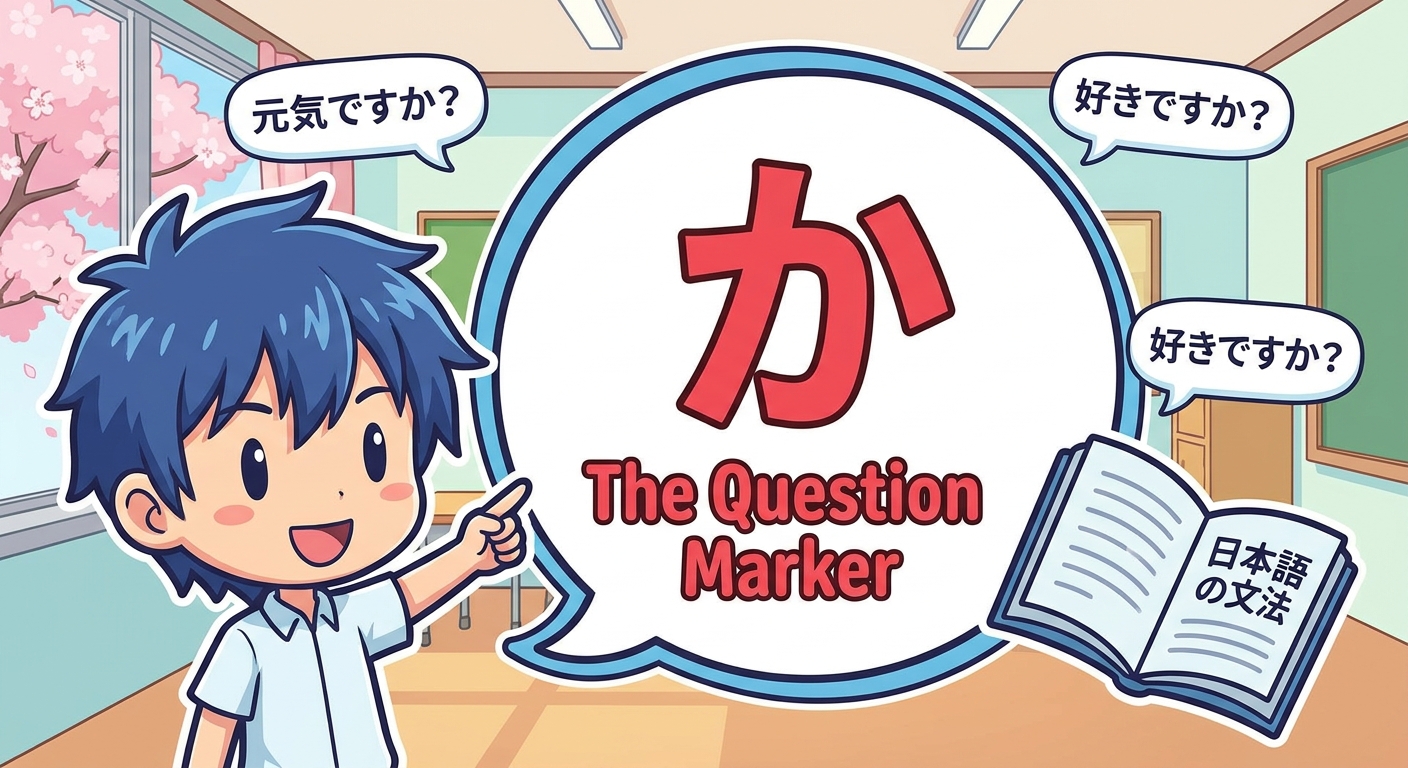
か — The Question Marker
Learn how to form yes/no questions in Japanese by adding か to the end of a statement. Also learn basic WH-question words: なに (what), だれ (who), どこ (where), いつ (when), どうして (why).
🎯 Goal: By the end of this lesson, you will be able to confidently use the particle か to form basic questions in polite Japanese, understand how to respond to these questions, and recognize the difference between standard statements and inquiries in both spoken and written contexts.
Introduction
Welcome to your first major step in interactive Japanese communication! In English, we rely on rising intonation or changing word order to ask a question. In Japanese, however, turning a statement into a question is beautifully simple: you just add the particle か (ka) to the very end of the sentence. Acting as a spoken question mark, this tiny but powerful particle is a cornerstone of N5 grammar. In this lesson, you will learn how to effortlessly transform polite statements into inquiries, enabling you to start engaging in real-world conversations and asking for information with confidence.
Lesson Content
Mastering the Japanese Question Marker: か (ka)
Level: JLPT N5
Welcome to your ultimate guide to one of the most fundamental particles in the Japanese language: か (ka).
In English, we signal a question by changing our word order (e.g., "You are a student" becomes "Are you a student?") or by adding a question mark at the end of a sentence. In Japanese, grammar is much friendlier. To turn almost any statement into a question, you simply keep the sentence structure exactly as it is and add the particle か to the very end.
Think of か as a spoken question mark.
1. The Basic Formula
Adding か to the end of a polite sentence instantly transforms it into a question.
With Nouns & Adjectives (です + か)
- Statement: これ は 本 です。 (Kore wa hon desu.) = This is a book.
- Question: これ は 本 ですか。 (Kore wa hon desu ka?) = Is this a book?
With Verbs (ます + か)
- Statement: 水 を 飲みます。 (Mizu wo nomimasu.) = I drink water.
- Question: 水 を 飲みますか。 (Mizu wo nomimasu ka?) = Will you drink water? / Do you drink water?
2. Intonation and Punctuation
The Pitch
When pronouncing か at the end of a question, your voice should rise slightly, just like it does at the end of an English question.
The Missing "?"
In traditional, formal Japanese writing, a question mark (?) is not used. Because the particle か already explicitly signals that the sentence is a question, a simple Japanese period (。) is used instead:
- Correct: そうですか。 (Is that so?)
- Note: In modern, casual writing (like manga or text messages), you will frequently see the question mark used (ですか?), but it is omitted in formal contexts.
3. Practical Examples in Context
Let's look at three essential N5 sentence patterns using か.
Example A: Asking "Who/What/Where" (Using Question Words)
When you use question words like 何 (nani - what), だれ (dare - who), or どこ (doko - where), you still need か at the end of the sentence.
- Japanese: これ は 何 ですか。
- Romaji: Kore wa nani desu ka.
- English: What is this?
Example B: Polite Invitations
In Japanese, asking a negative question with か is a highly polite way to invite someone to do something (similar to "Won't you...?" in English).
- Japanese: いっしょに 行きませんか。
- Romaji: Isshoni ikimasen ka.
- English: Won't you come/go with me? (Shall we go together?)
4. Elite Tutor Pro-Tip: Casual vs. Polite Questions
Be careful! か is primarily used to end polite sentences (ending in desu or masu).
If you add か to a casual, plain-form verb, it can sound sharp, masculine, or demanding.
- Polite & Natural: 行きますか。 (Ikimasu ka? - Are you going?)
- Casual & Harsh: 行くか。 (Iku ka? - You going? / Shall we go? - Sounds very blunt).
The Casual Solution: In casual Japanese, speakers simply drop か entirely and use a rising intonation on the last word.
- Casual & Natural: 行く? (Iku? [with rising pitch] - Going?)
Quick Summary
- か acts as a verbal question mark at the end of a sentence.
- It does not require you to change the word order of the sentence.
- In formal writing, end the sentence with a period (。), not a question mark.
- Keep か paired with polite forms (desu/masu) to maintain a friendly, natural tone!
Exercises
か — The Question Marker (Exercises)
Exercises for か — The Question Marker
Review the grammar and vocabulary, and try to fill in the blanks or write sentences based on the prompts.
Examples
これは本ですか。
Kore wa hon desu ka.
Is this a book?
トイレはどこですか。
Toire wa doko desu ka.
Where is the restroom?
明日、学校へ行きますか。
Ashita, gakkō e ikimasu ka.
Will you go to school tomorrow?
Practice Drills
Lesson Materials
Vocabulary (5)
Grammar (3)
Kanji (0)
No kanji characters in this lesson.
Kana (0)
No kana characters in this lesson.