
も / じゃありません — Also and Negative
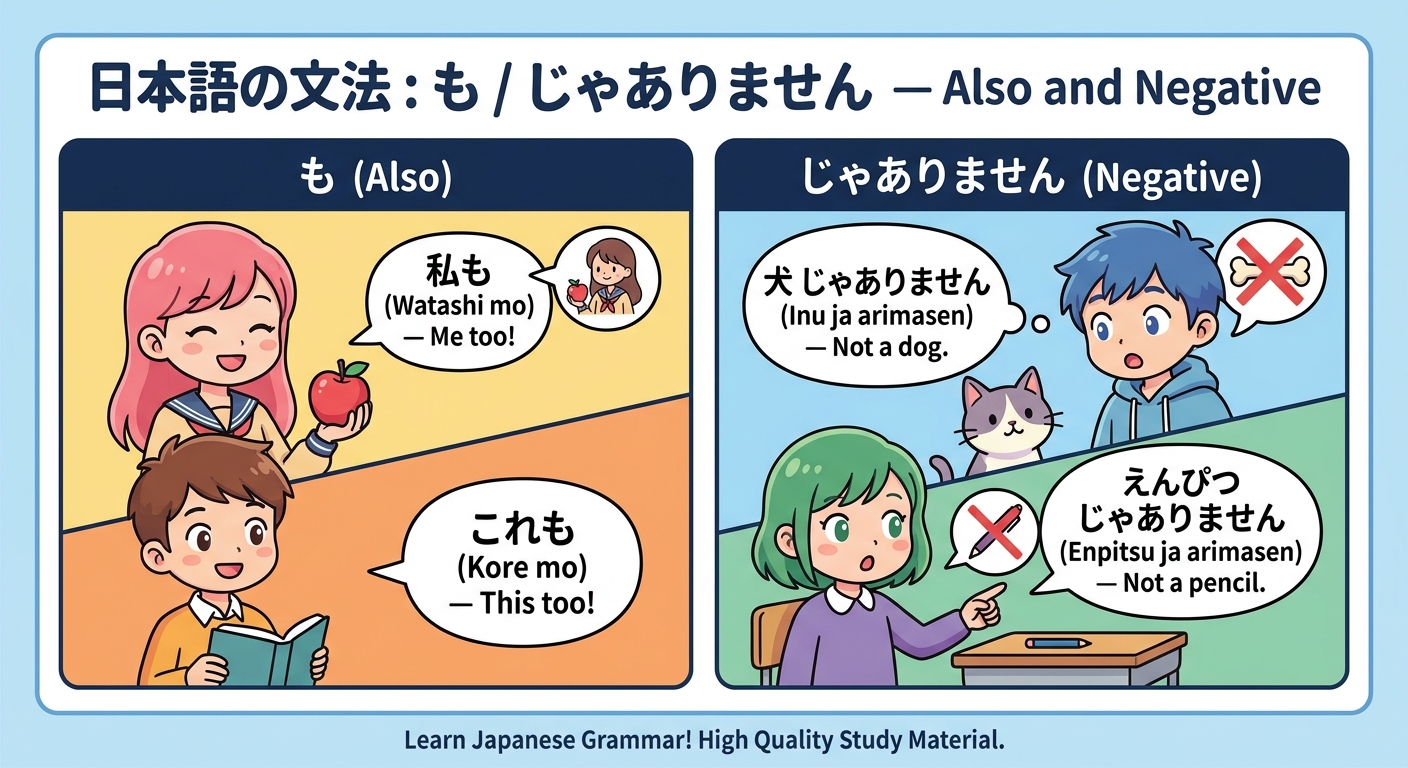
Learn も (also/too) as an inclusive particle and じゃありません as the polite negative of です. Practice converting positive noun sentences to negative and 'also' forms.
🎯 Goal: By the end of this lesson, you will be able to confidently use the particle 'も' to connect similar concepts and the negative form 'じゃありません' to deny statements or clarify identity in polite, everyday Japanese conversations.
Introduction
Welcome to your journey into essential Japanese sentence patterns! In this lesson, you will master two fundamental grammar points that will instantly boost your conversational ability: the particle も (mo) and the negative polite form じゃありません (ja arimasen). You will learn how to use も to express 'also' or 'too' when linking similar ideas, and how to use じゃありません to politely negate nouns and state what something is not. Together, these structures allow you to build more nuanced, natural descriptions and engage in polite everyday conversations with confidence. Let's get started!
Lesson Content
N5 Japanese Mastery: Expressing "Also" (も) and "Is Not" (じゃありません)
Welcome to your ultimate guide to N5 Japanese! Today, we are mastering two fundamental building blocks of Japanese grammar: も (mo), the particle for "also/too," and じゃありません (ja arimasen), the polite negative form of "to be."
By the end of this lesson, you will be able to confidently introduce yourself, describe others, and state what things are—and are not.
1. The Particle も (mo) — "Also / Too"
In Japanese, particles are small words added to the end of nouns to define their grammatical role.
The particle も (mo) is used to indicate that what you are saying applies to this noun as well. It translates directly to "also" or "too" in English.
The Golden Rule of も: Replacement
When you want to say "also," も completely replaces the topic marker は (wa) or the subject marker が (ga). Do not use them together!
- Incorrect: ❌ わたしはも学生です。(Watashi wa mo gakusei desu.)
- Correct: can be written as:
- 私は学生です。 (I am a student.)
- 鈴木さんも学生です。 (Suzuki-san mo gakusei desu. / Mr. Suzuki is also a student.)
Quick Stroke Order Tip for も:
To write も beautifully, follow these three steps:
- Draw the long central hook starting from the top, curving to the right (like the hiragana し).
- Draw the top horizontal line from left to right.
- Draw the bottom horizontal line from left to right.
2. Negation: じゃありません (ja arimasen) — "Is Not"
To say something is something, we use です (desu). To say something is not, we use じゃありません (ja arimasen). This is the polite, negative form used for nouns and na-adjectives.
Grammar Structure
$$\text{Noun} + \text{じゃありません}$$
Examples:
- 私は先生じゃありません。
- Romaji: Watashi wa sensei ja arimasen.
- English: I am not a teacher.
- これは水じゃありません。
- Romaji: Kore wa mizu ja arimasen.
- English: This is not water.
Formality Spectrum (Bonus Knowledge)
Depending on who you are talking to, you can change the level of formality:
| Formality | Japanese | Usage |
|---|---|---|
| Formal / Written | ではあいません (de wa arimasen) | Speeches, business emails |
| Polite / Spoken | じゃありません (ja arimasen) | Daily polite conversation (N5 Standard) |
| Casual | じゃない (ja nai) | Friends and family |
3. Putting It All Together: A Conversational Example
Let’s see how も and じゃありません work together in a realistic N5 dialogue.
A: ミラーさんは会社員(かいしゃいん)ですか。
(Mirā-san wa kaishain desu ka?)
"Is Mr. Miller an office worker?"
B: はい、ミラーさんは会社員です。
(Hai, Mirā-san wa kaishain desu.)
"Yes, Mr. Miller is an office worker."
A: サントスさんも会社員ですか。
(Santosu-san mo kaishain desu ka?)
"Is Mr. Santos also an office worker?"
B: いいえ、サントスさんは会社員じゃありません。学生(がくせい)です。
(Iie, Santosu-san wa kaishain ja arimasen. Gakusei desu.)
"No, Mr. Santos is not an office worker. He is a student."
4. Practice Challenge
Test your skills! Translate the following sentences into Japanese. (Scroll down for answers)
- I am Japanese. (Japanese = 日本人 / Nihonjin)
- Tanaka-san is also Japanese.
- I am not a doctor. (Doctor = 医者 / Isha)
Answers
- 私は日本人です。(Watashi wa Nihonjin desu.)
- 田中さんも日本人です。(Tanaka-san mo Nihonjin desu.)
- 私は医者じゃありません。(Watashi wa isha ja arimasen.)
You've mastered these two essential N5 structures! Keep practicing, and your Japanese will continue to flourish! がんばってください!
Exercises
も / じゃありません — Also and Negative (Exercises)
Exercises for も / じゃありません — Also and Negative
Review the grammar and vocabulary, and try to fill in the blanks or write sentences based on the prompts.
Examples
田中さんは先生じゃありません。鈴木さんも先生じゃありません。
Tanaka-san wa sensei ja arimasen. Suzuki-san mo sensei ja arimasen.
Mr. Tanaka is not a teacher. Mr. Suzuki is also not a teacher.
これは水じゃありません。それも水じゃありません。
Kore wa mizu ja arimasen. Sore mo mizu ja arimasen.
This is not water. That is also not water.
私は学生じゃありません。トムさんも学生じゃありません。
Watashi wa gakusei ja arimasen. Tomu-san mo gakusei ja arimasen.
I am not a student. Tom is also not a student.
Practice Drills
Lesson Materials
Vocabulary (5)
Grammar (3)
Kanji (0)
No kanji characters in this lesson.
Kana (0)
No kana characters in this lesson.