
くない / Past い-Adjective Forms
Learn how to negate い-adjectives (おいしい→おいしくない) and form the past tense (おいしかった). Build a complete 4-form table for each adjective.
🎯 Goal: By the end of this lesson, you will be able to confidently conjugate N5-level い-adjectives into their negative (〜くない), past affirmative (〜かった), and past negative (〜くなかった) forms, and use them accurately in polite and casual sentences to describe past states and experiences.
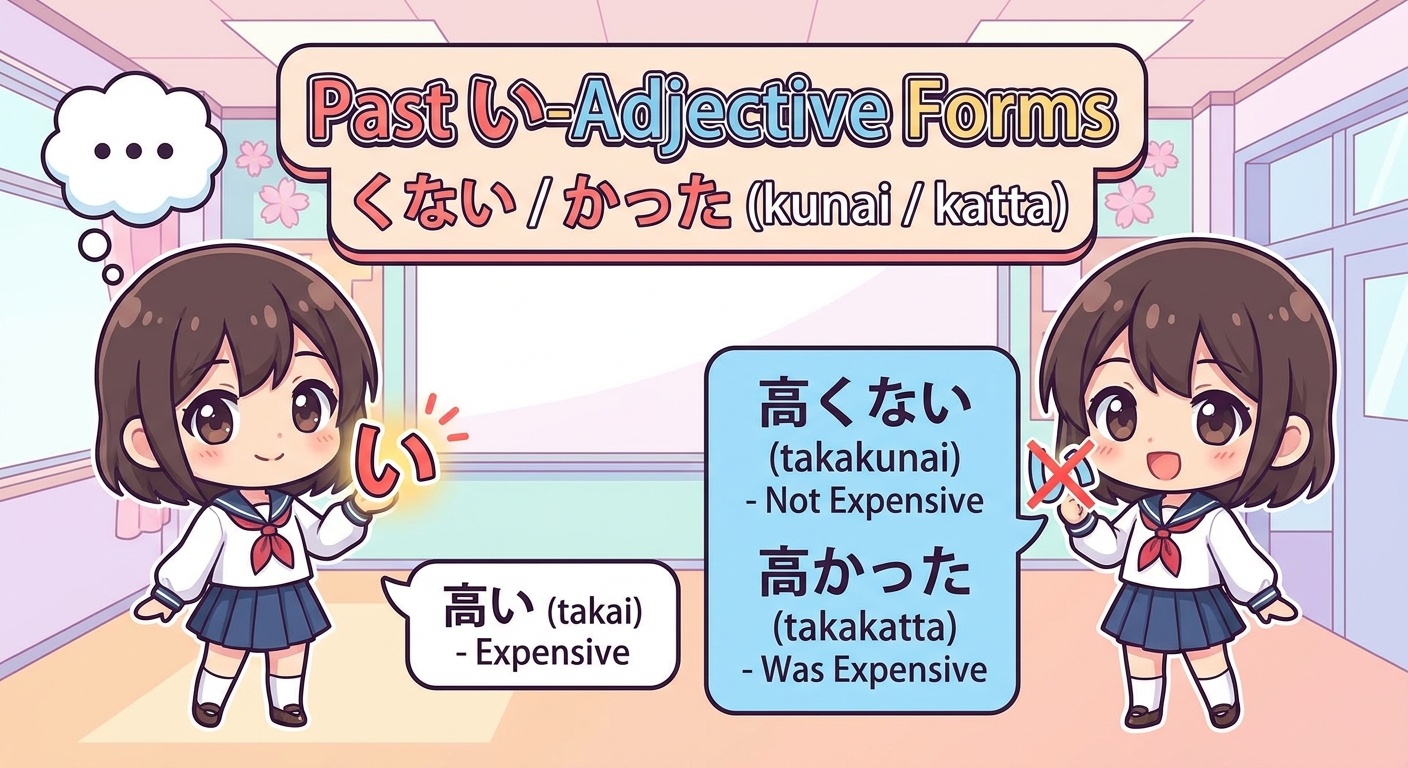
Introduction
Welcome to your essential guide to Japanese い-adjectives (i-adjectives)! In Japanese, adjectives act much like verbs, changing their endings to show tense and polarity. In this lesson, you will master how to transform these adjectives into their negative form using 〜くない (is not...) and their past-tense forms, including the past-negative 〜くなかった (was not...). Understanding these inflections is a crucial milestone in your N5 journey, allowing you to describe past experiences, express preferences, and talk about the weather. Let’s unlock the flexibility of Japanese adjectives together!
Lesson Content
Master Class: Conjugating Japanese い-Adjectives (N5)
Welcome to your definitive guide to mastering い-adjectives (i-adjectives) in the negative and past tenses.
In Japanese, adjectives are incredibly dynamic. Unlike English adjectives, Japanese い-adjectives act almost like verbs—they conjugate directly to show tense (present/past) and polarity (affirmative/negative).
By the end of this guide, you will confidently transform words like samui (cold) into "was not cold" (samukunakatta). Let’s dive in!
The Golden Rule: Drop the ~い (i)
To conjugate any い-adjective, your starting step is always the same: Drop the final ~い and attach the correct suffix.
Here is your master conjugation matrix using 暑い (あつい - atsui / hot):
| Tense | Casual Form | Polite Form (Add です) | Meaning |
|---|---|---|---|
| Present Affirmative | 暑い (atsui) | 暑いです | It is hot. |
| Present Negative | 暑くない (atsukunai) | 暑くないです | It is not hot. |
| Past Affirmative | 暑かった (atsukatta) | 暑かったです | It was hot. |
| Past Negative | 暑くなかった (atsukunakatta) | 暑くなかったです | It was not hot. |
Step-by-Step Conjugation breakdown
1. Present Negative: ~くない (kunai)
To say something is not [adjective], drop the final い and add くない.
- Example: 寒い (samui / cold) $\rightarrow$ 寒くない (samukunai / not cold)
- Polite: 寒くないです (samukunai desu)
2. Past Affirmative: ~かった (katta)
To say something was [adjective], drop the final い and add かった.
- Common Mistake: Do not say samui deshita. You must conjugate the adjective itself!
- Example: 寒い (samui) $\rightarrow$ 寒かった (samukatta / was cold)
- Polite: かったです (samukatta desu)
3. Past Negative: ~くなかった (kunakatta)
To say something was not [adjective], drop the final い and add くなかった.
- Pro Tip: Think of this as taking the negative form (~くない), dropping the final い, and adding かった (~くなく + かった).
- Example: 寒い (samui) $\rightarrow$ 寒くなかった (samukunakatta / was not cold)
- Polite: 寒くなかったです (samukunakatta desu)
⚠️ The Crucial Exception: いい (ii / Good)
The word for "good" is いい (ii) or 良い (yoi).
When conjugating this adjective, you must use the stem よ (yo). You cannot conjugate ii directly.
- Good: いい / よい (ii / yoi)
- Not good: よくない (yokunai)
- Was good: よかった (yokatta)
- Was not good: よくなかった (yokunakatta)
Contextual Examples
Let's look at how these look in real N5-level sentences.
-
Present Negative (Polite):
- このお茶は熱くないです。
- Kono ocha wa atsukunai desu.
- This tea is not hot.
-
Past Affirmative (Polite):
- 昨日のテストは難しかったです。
- Kinou no tesuto wa muzukashikatta desu.
- Yesterday's test was difficult.
-
Past Negative (Casual):
- 映画はあまり面白くなかった。
- Eiga wa amari omoshirokunatta.
- The movie wasn't very interesting.
Quick Challenge!
Test your skills. Try to conjugate the adjective 安い (やすい - yasui / cheap) into the following forms. (Scroll down for answers!)
- It is not cheap (Polite)
- It was cheap (Casual)
- It was not cheap (Polite)
Answers:
- 安くないです (yasukunai desu)
- 安かった (yasukatta)
- 安くなかったです (yasukunakatta desu)
Exercises
くない / Past い-Adjective Forms (Exercises)
Exercises for くない / Past い-Adjective Forms
Review the grammar and vocabulary, and try to fill in the blanks or write sentences based on the prompts.
Examples
今日は寒くないです。
Kyou wa samukunai desu.
Today is not cold.
昨日のテストは難しかったです。
Kinou no tesuto wa muzukashikatta desu.
Yesterday's test was difficult.
あの映画は面白くなかったです。
Ano eiga wa omoshirokunakatta desu.
That movie was not interesting.
Practice Drills
Lesson Materials
Vocabulary (5)
Grammar (3)
Kanji (0)
No kanji characters in this lesson.
Kana (0)
No kana characters in this lesson.