
Basic い-Adjectives
Learn the most common い-adjectives: おいしい (delicious), あつい (hot), さむい (cold), たかい (expensive/tall), やすい (cheap), おおきい (big), ちいさい (small). Learn how they modify nouns and form predicates.
🎯 Goal: By the end of this lesson, you will be able to identify key N5 い-adjectives, use them to modify nouns directly, and confidently conjugate them into present affirmative and negative forms to make basic descriptive statements.
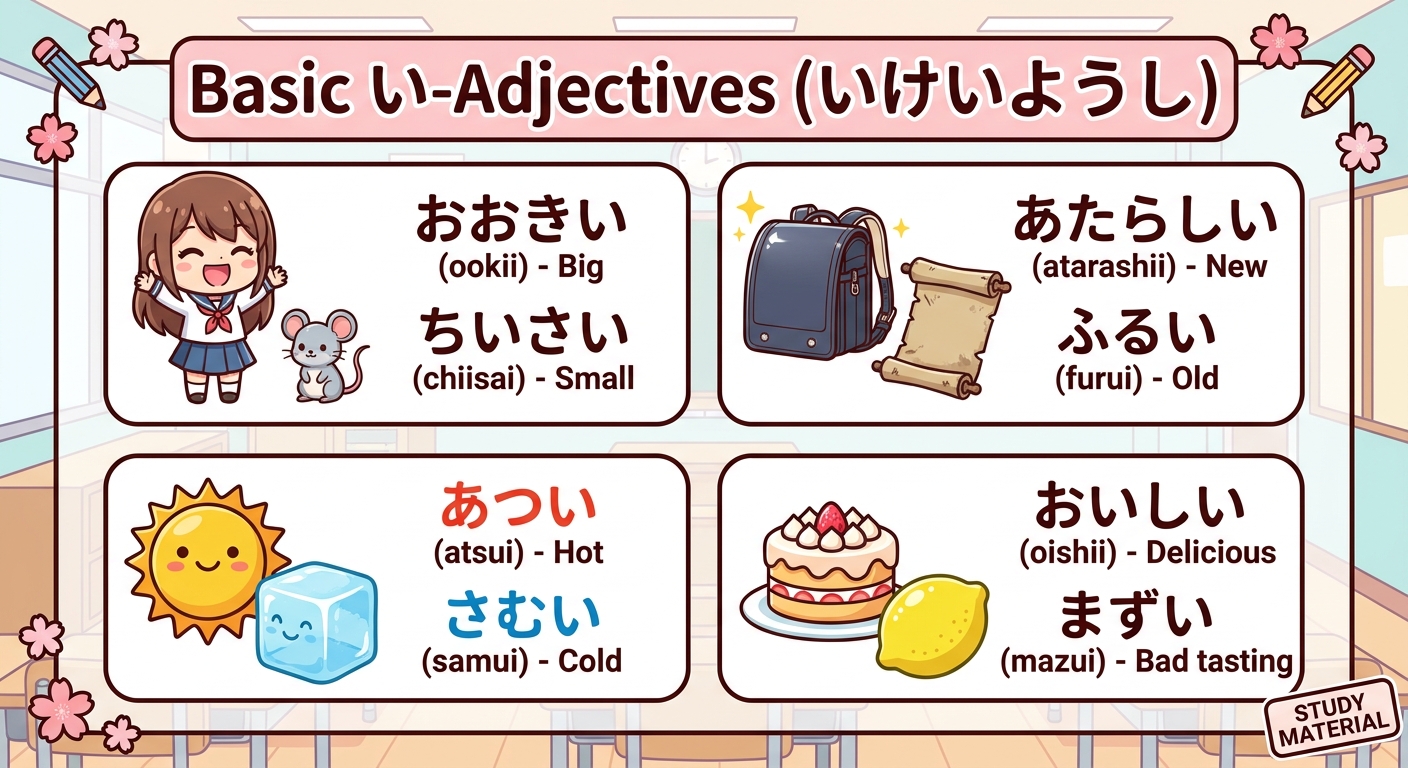
Introduction
Welcome to your essential guide to Japanese い-adjectives (i-adjectives), a fundamental building block of the JLPT N5 vocabulary. Adjectives in Japanese are unique because they inflect like verbs to show tense and polarity. In this lesson, you will learn how to identify, use, and conjugate basic い-adjectives to describe the world around you—from the weather to your feelings. Mastering these words will immediately boost your conversational ability, allowing you to express opinions, describe objects, and share experiences naturally. Let’s unlock the power of Japanese descriptive language and elevate your speaking skills today.
Lesson Content
Master N5 Grammar: The Power of な-Adjectives (な形容詞)
Welcome, future Japanese masters! Today, we are diving into one of the two foundational pillars of Japanese description: な-adjectives (Na-adjectives).
By the end of this guide, you will know how to describe people, places, and things, conjugate these adjectives into the past and negative forms, and avoid the most common traps beginner students fall into.
1. What is a な-Adjective?
In Japanese, adjectives are divided into two groups: い-adjectives and な-adjectives.
Unlike い-adjectives (which naturally end in the hiragana ~i), な-adjectives behave grammatically like nouns. In their base form, they do not have "な" attached to them. They are only called "な-adjectives" because we must insert "な" (na) between the adjective and the noun it describes.
Essential N5 Vocabulary List
Here are five high-frequency N5 な-adjectives to memorize:
| Kanji | Hiragana | Romaji | Meaning |
|---|---|---|---|
| 静か | しずか | shizuka | Quiet |
| 親切 | しんせつ | shinsetsu | Kind |
| 元気 | げんき | genki | Healthy / Energetic |
| 暇 | ひま | hima | Free (not busy) |
| 綺麗 | きれい | kirei | Beautiful / Clean |
2. How to Use Them in a Sentence
There are two primary ways to use a な-adjective.
Pattern A: Modifying a Noun (Attributive)
To describe a noun directly, place the adjective before the noun and connect them with な.
$$\text{[な-Adjective]} + \mathbf{\text{な}} + \text{[Noun]}$$
- 静かな公園 (しずかなこうえん / shizuka na kouen)
- A quiet park.
- 親切な先生 (しんせつなせんせい / shinsetsu na sensei)
- A kind teacher.
Pattern B: Ending a Sentence (Predicative)
If the adjective comes at the end of the sentence (e.g., "The park is quiet"), do not use な. Instead, end the sentence with です (desu) for politeness.
$$\text{[Subject]} + \mathbf{\text{は}} + \text{[な-Adjective]} + \mathbf{\text{です}}$$
- この公園は静かです。 (Kono kouen wa shizuka desu.)
- This park is quiet.
- 先生は親切です。 (Sensei wa shinsetsu desu.)
- The teacher is kind.
3. Conjugation Rules (Polite Form)
Because な-adjectives behave like nouns, they share the exact same conjugation patterns as nouns. You only need to change the です at the end.
Let's conjugate 元気 (げんき / energetic):
| Tense | Form | Japanese Example | Romaji | English Translation |
|---|---|---|---|---|
| Present Affirmative | です | 元気です | Genki desu | I am energetic. |
| Present Negative | じゃありません | 元気じゃありません | Genki ja arimasen | I am not energetic. |
| Past Affirmative | でした | 元気でした | Genki deshita | I was energetic. |
| Past Negative | じゃありませんでした | 元気じゃありませんでした | Genki ja arimasen deshita | I was not energetic. |
(Note: For the negative forms, you can also use ではないです / de wa nai desu instead of じゃありません in casual-polite speech).
4. ⚠️ The "Kirei" Trap (Crucial N5 Tip!)
Look closely at the word 綺麗 (きれい / kirei - beautiful/clean).
It ends with the sound "i". Because of this, many beginners mistakenly conjugate it as an い-adjective (e.g., writing kireikunai). Do not fall for this!
Kirei is a な-adjective.
- ❌ Kirei deshita (Past) $\rightarrow$ Correct!
- ❌ Kireikatta $\rightarrow$ Incorrect!
Another common N5 exception is 嫌い (きらい / kirai - to hate/dislike), which is also a な-adjective.
5. Practice Challenge!
Test your skills by translating these three sentences into Japanese. (Answers below!)
- A clean room. (Room = 部屋 / へや)
- This town was quiet. (Town = 町 / まち)
- I am not free today. (Today = 今日 / きょう)
Answers:
- 綺麗な部屋 (きれいなへや / kirei na heya)
- この町は静かでした。 (Kono machi wa shizuka deshita.)
- 今日は暇じゃありません。 (Kyou wa hima ja arimasen.)
Keep practicing, and you will master Japanese adjectives in no time! がんばってください (Good luck)!
Exercises
Basic な-Adjectives (Exercises)
Exercises for Basic な-Adjectives
Review the grammar and vocabulary, and try to fill in the blanks or write sentences based on the prompts.
Examples
この時計は高いです。
Kono tokei wa takai desu.
This watch is expensive.
今日はとても寒いです。
Kyou wa totemo samui desu.
Today is very cold.
日本の食べ物は美味しいです。
Nihon no tabemono wa oishii desu.
Japanese food is delicious.
Practice Drills
Lesson Materials
Vocabulary (5)
Grammar (3)
Kanji (0)
No kanji characters in this lesson.
Kana (0)
No kana characters in this lesson.