
とても / あまり — Degree Words
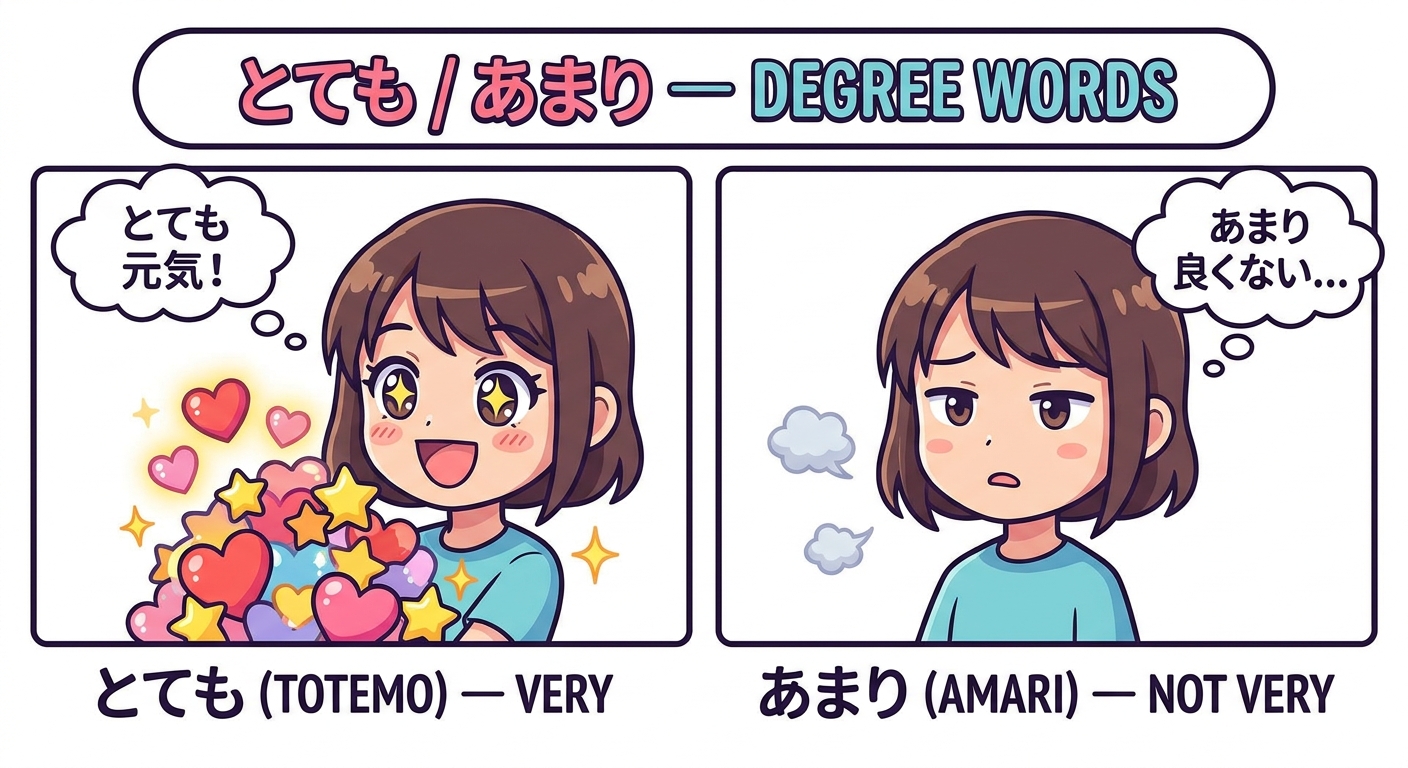
Learn intensity modifiers: とても (very), まあまあ (so-so), あまり+negative (not much), ぜんぜん+negative (not at all). Use them naturally before adjectives.
🎯 Goal: To confidently use "とても" and "あまり" with adjectives and verbs to express varying degrees of intensity, paying close attention to grammatical agreement with positive and negative sentence structures.
Introduction
Welcome to this lesson on N5 degree modifiers! In Japanese, expressing the intensity of an action, state, or feeling is essential for natural communication. Today, we will focus on two fundamental degree adverbs: とても (totemo), meaning "very," and あまり (amari), meaning "not very" or "not much." Understanding how these words function is key to expanding your descriptive range. Crucially, you will learn how とても pairs with positive sentences, while あまり must always be used with negative sentence endings. By mastering these two words, you will be able to express nuance and share your opinions with greater accuracy.
Lesson Content
Master Japanese N5: Expressing Degree with とても and あまり
Welcome to your N5 grammar masterclass! Today, we are going to learn how to express how much or to what extent something is true. In Japanese, we do this using degree adverbs.
We will focus on two of the most essential degree words in the Japanese language: とても (totemo) and あまり (amari). Mastering these will instantly make your descriptions sound more natural and nuanced.
1. とても (totemo) — "Very" / "Extremely"
とても is used to amplify the quality of an adjective or the intensity of an action.
- The Golden Rule: とても must always be paired with an affirmative (positive) ending.
Grammar Pattern
$$\text{とても} + \text{Affirmative Adjective / Verb}$$
Examples
-
With $i$-Adjectives:
- 日本の夏はとても暑いです。
- Nihon no natsu wa totemo atsui desu.
- Summer in Japan is very hot.
-
With $na$-Adjectives:
- この町はとても静かです。
- Kono machi wa totemo shizuka desu.
- This town is very quiet.
-
With Verbs:
- 日本語の勉強がとても好きです。
- Nihongo no benkyō ga totemo suki desu.
- I like studying Japanese very much.
2. あまり (amari) — "Not very" / "Not much"
あまり is the opposite of とても, but it comes with a critical grammatical twist that is frequently tested on the JLPT N5 exam.
- The Golden Rule: あまり must always be paired with a negative ending. Even though "not" is included in the English translation, the Japanese sentence must physically end in a negative form (like 〜ない, 〜ません, or 〜じゃありません).
Grammar Pattern
$$\text{あまり} + \text{Negative Adjective / Verb}$$
Examples
-
With $i$-Adjectives (Negative):
- このスープはあまり熱くないです。
- Kono sūpu wa amari atsukunai desu.
- This soup is not very hot. (Note: 暑い/熱い becomes 熱くない in the negative).
-
With $na$-Adjectives (Negative):
- あの図書館はあまり静かじゃありません。
- Ano toshokan wa amari shizuka ja arimasen.
- That library is not very quiet.
-
With Verbs (Negative):
- 私はテレビをあまり見ません。
- Watashi wa terebi o amari mimasen.
- I do not watch TV very much.
Quick Comparison Table
| Degree Word | Meaning | Sentence Ending Required | Example |
|---|---|---|---|
| とても (totemo) | Very / Extremely | Affirmative (〜です / 〜ます) | とても美味しいです。<br>(It is very delicious.) |
| あまり (amari) | Not very / Not much | Negative (〜ない / 〜ません) | あまり美味しくないです。<br>(It is not very delicious.) |
💡 Tutor Tip on Politeness: In Japanese culture, direct negative opinions can sound harsh. Instead of saying "This food is bad" (この食べ物はまずいです), Japanese speakers prefer to soften the blow by saying "This food is not very delicious" (この食べ物はあまり美味しくないです).
Practice Exercises
Test your skills! Fill in the blanks with either とても or あまり.
- この本は _______ 面白い(おもしろい)です。
(This book is very interesting.) - 英語(えいご)は _______ 難しくない(むずかしくない)です。
(English is not very difficult.) - 今日(きょう)は忙しい(いそがしい)ですから、お酒(さけ)を _______ 飲みません。
(Because I am busy today, I won't drink much alcohol.)
Answers
- とても (Matches the affirmative ending omoshiroi desu)
- あまり (Matches the negative adjective ending muzukashikunai desu)
- あまり (Matches the negative verb ending nomimasen)
Exercises
とても / あまり — Degree Words (Exercises)
Exercises for とても / あまり — Degree Words
Review the grammar and vocabulary, and try to fill in the blanks or write sentences based on the prompts.
Examples
このラーメンはとても美味しいです。
Kono rāmen wa totemo oishii desu.
This ramen is very delicious.
今日はあまり寒くないです。
Kyō wa amari samukunai desu.
Today is not very cold.
私はあまりテレビを見ません。
Watashi wa amari terebi o mimasen.
I do not watch TV very much.
Practice Drills
Lesson Materials
Vocabulary (5)
Grammar (3)
Kanji (0)
No kanji characters in this lesson.
Kana (0)
No kana characters in this lesson.