
Emails and Polite Messages
Read formal and semi-formal written communication: emails, invitations, and notices. Understand the purpose and the required response.
🎯 Goal: To confidently draft, format, and send standard polite emails and messages in Japanese, utilizing appropriate N3-level honorifics (keigo), common business greetings, and polite request structures suitable for workplace and formal communication.
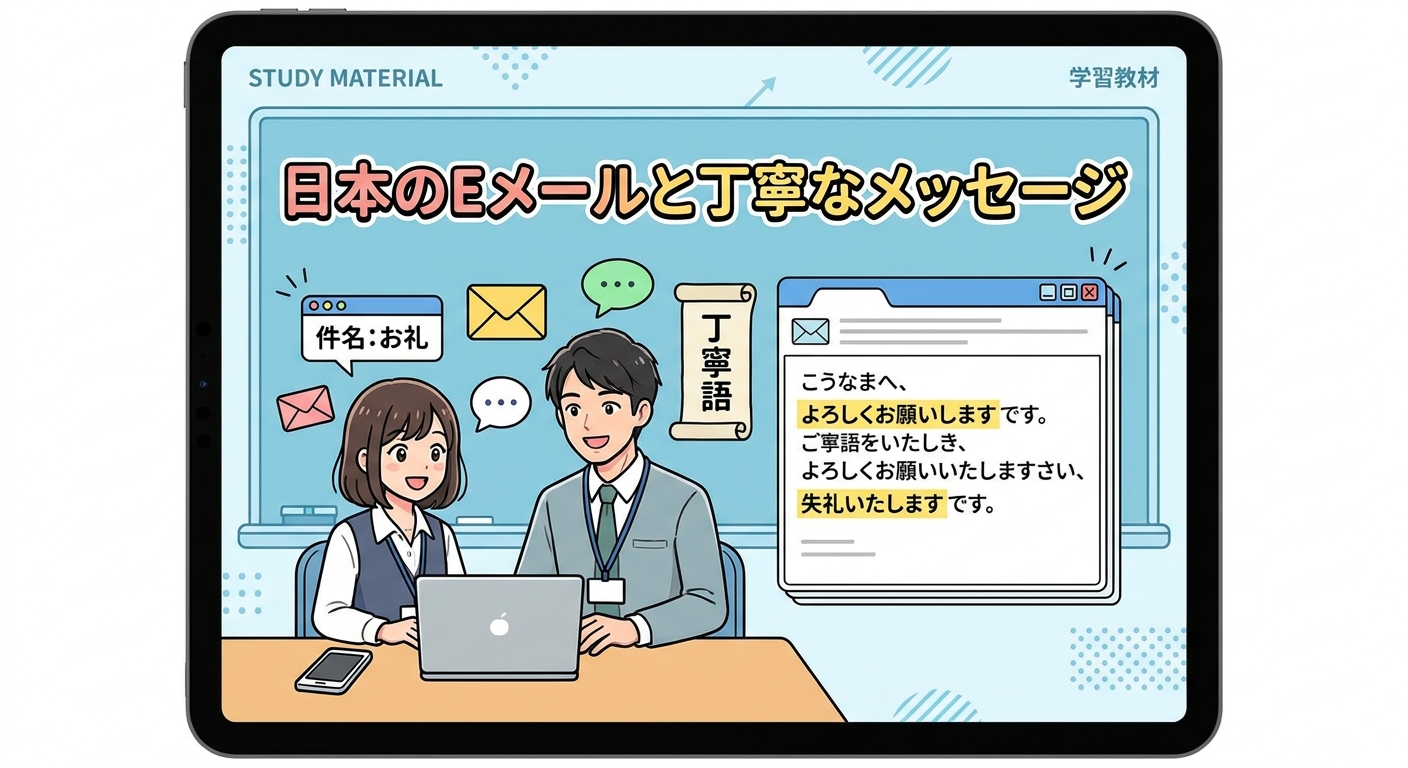
Introduction
Navigating professional communication in Japanese requires a shift from spoken fluency to structured written etiquette. This lesson introduces the essential conventions of writing emails and polite messages at the JLPT N3 level. You will learn how to transition from basic polite Japanese to natural business correspondence. We will cover standard email formatting, crucial opening and closing formulas (such as 'osewa ni natte orimasu'), and how to make polite requests or inquiries without sounding demanding. Mastering these written nuances will build your confidence in interacting with Japanese colleagues, clients, and institutions.
Lesson Content
Elite Japanese Study Guide: Mastering N3 Business Emails & Polite Messages
In the Japanese professional world, writing an email is not just about conveying information—it is an art of maintaining harmony (wa) and showing respect. At the JLPT N3 level, you transition from casual polite Japanese (Desu/Masu) to basic business honorifics (Keigo).
This guide breaks down the essential anatomy, vocabulary, and grammar patterns needed to write natural, polite Japanese emails.
1. The 5-Step Anatomy of a Japanese Email
Every standard business email in Japan follows a strict, predictable structure. Master this template, and you will write emails with confidence.
| Section | Japanese Name | Purpose | Example |
|---|---|---|---|
| 1. Subject Line | 件名 (Kenmei) | Clear, concise topic. | 【打ち合わせ日程のご相談】 (Consultation on meeting schedule) |
| 2. Recipient | 宛先 (Atesaki) | Company, Department, Name + Title/Sama. | ◯◯株式会社 鈴木様 (Suzuki-sama of OO Corporation) |
| 3. Greeting | 挨拶 (Aisatsu) | Standard polite opener. | いつもお世話になっております。 (Thank you for your continued support.) |
| 4. Main Body | 本文 (Honbun) | The core message (use Keigo). | 来週の会議についてご連絡いたしました。 (I am contacting you regarding next week's meeting.) |
| 5. Closing | 結び (Musubi) | Standard polite sign-off. | よろしくお願いいたします。 (Best regards.) |
2. Key N3 Grammar Patterns for Requests
When asking for favors or information, direct requests sound rude. Use these polite N3 structures instead:
A. 〜ていただけないでしょうか (Could you please...?)
This is the gold standard for making polite requests to superiors or clients.
- Formula: Verb [Te-form] + いただけないでしょうか
- Example:
- 資料を送付していただけないでしょうか。
- Shiryō o sōfu shite itadakenai deshō ka.
- Could you please send the documents?
B. 〜ていただけますと幸いです (I would be grateful if you could...)
A softer, highly professional way to make a request. Saivai (幸い) means "happiness/good fortune."
- Formula: Verb [Te-form] + いただけますと幸いです
- Example:
- 明日までにご返信いただけますと幸いです。
- Ashita made ni go-henshin itadakemasu to saiwai desu.
- I would highly appreciate it if you could reply by tomorrow.
3. Essential Humble (Kenjougo) Verbs for N3
To show respect to your reader, you must lower your own actions using Humble Japanese (Kenjougo).
- する (To do) $\rightarrow$ いたします (Itashimasu)
- ご連絡いたします。 (I will contact you.)
- 行く / 来る (To go / To come) $\rightarrow$ 参ります (Mairimasu) or 伺います (Ukagaimasu - to visit/ask)
- 明日、10時に弊社へ伺います。 (I will visit your office tomorrow at 10:00.)
- 言う (To say) $\rightarrow$ 申し上げます (Mōshiagemasu)
- お礼申し上げます。 (I offer my gratitude.)
4. Model Email: Rescheduling a Meeting
Here is a practical N3-level email requesting to change a meeting time.
Subject: 【面談日程変更のお願い】(Your Name)
◯◯株式会社
採用担当 高橋様いつもお世話になっております。
[Your Name]でございます。来週月曜日の面談の件についてご連絡いたしました。
大変申し訳ございませんが、急用が入ってしまい、お約束の時間に伺うことが難しくなってしまいました。つきましては、日程を以下のように変更していただけないでしょうか。
- 候補1:10月15日(火)14:00〜
- 候補2:10月16日(水)11:00〜
お忙しいところお手数をおかけしますが、ご検討いただけますと幸いです。
どうぞよろしくお願いいたします。
English Translation:
Subject: [Request to Change Interview Schedule] (Your Name)
Takahashi-sama, Hiring Department, OO Corporation
Thank you very much for your continued support. This is [Your Name].
I am contacting you regarding next Monday's interview. I am incredibly sorry, but due to urgent business, it has become difficult for me to visit at the promised time.
Therefore, would it be possible to reschedule to one of the following times?
- Option 1: Oct 15 (Tue) 14:00~
- Option 2: Oct 16 (Wed) 11:00~
I apologize for the inconvenience during your busy schedule, but I would be grateful for your consideration.
Best regards.
💡 Quick Pro-Tip
Never end a business email with さようなら (Sayōnara). Always close with よろしくお願いいたします (Yoroshiku onegai itashimasu), which acts as a polite anchor, wrapping up your message with mutual goodwill.
Exercises
Emails and Polite Messages (Exercises)
Exercises for Emails and Polite Messages
Review the grammar and vocabulary, and try to fill in the blanks or write sentences based on the prompts.
Examples
お忙しいところ恐縮ですが、来週のご都合はいかがでしょうか。
Oisogashii tokoro kyōshuku desu ga, raishū no gotsugō wa ikaga deshō ka.
I am sorry to bother you when you are busy, but how is your availability next week?
先ほどお送りいただいた資料を確かに受け取りました。
Sakihodo oori itadaita shiryō o tashika ni uketorimashita.
I have successfully received the documents you sent me a moment ago.
返信が遅くなってしまい、大変申し訳ございません。
Henshin ga osoku natte shimai, taihen mōshiwake gozaimasen.
I am very sorry for the delay in my reply.
Practice Drills
Lesson Materials
Vocabulary (5)
Grammar (3)
Kanji (0)
No kanji characters in this lesson.
Kana (0)
No kana characters in this lesson.