
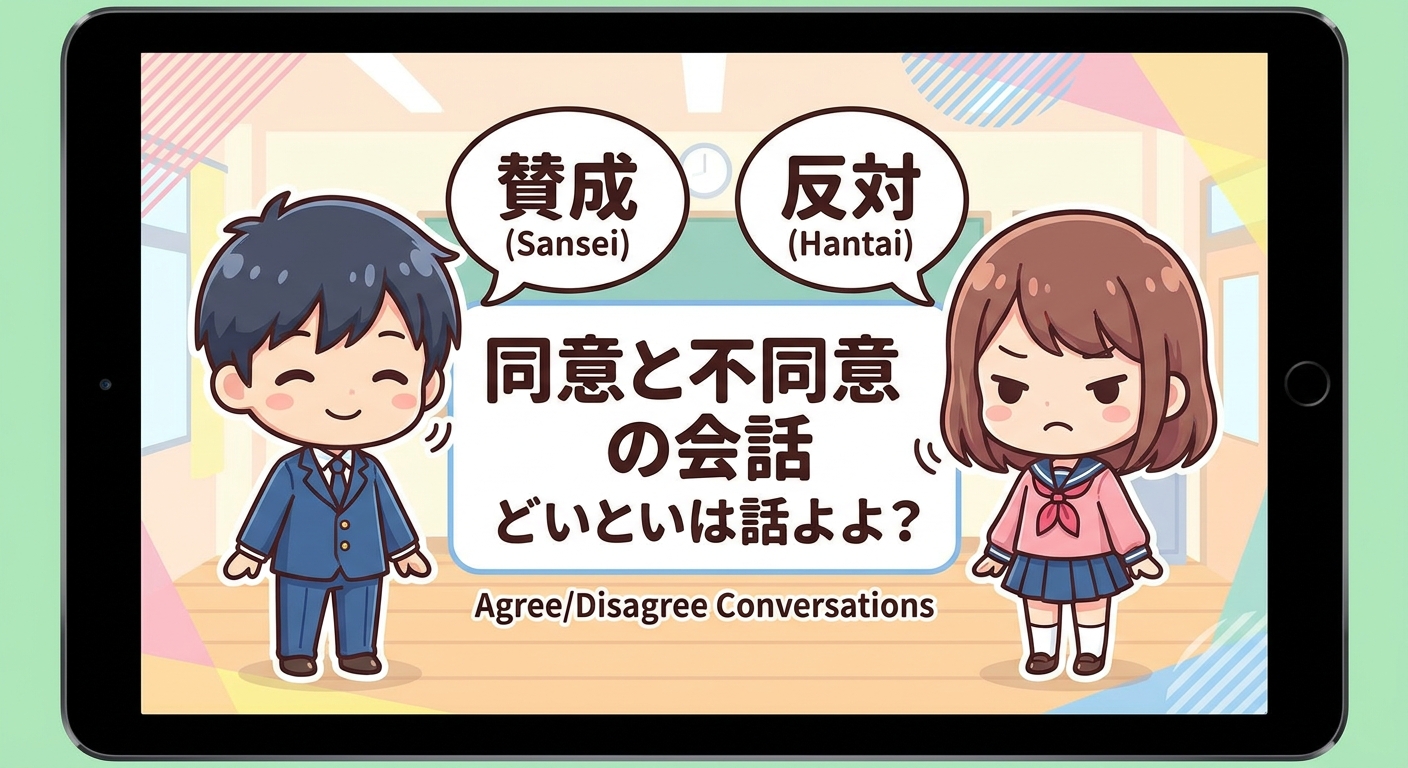
Agree/Disagree Conversations
Understand conversations where speakers express and respond to opinions. Track who agrees, disagrees, or is uncertain.
🎯 Goal: By the end of this lesson, you will be able to confidently express agreement and disagreement in Japanese, support your opinions with clear reasons using N3 grammar, and employ polite hedging techniques to disagree respectfully in both professional and social contexts.
Introduction
Welcome to the N3 lesson on 'Agree/Disagree Conversations.' At the intermediate level, communication transitions from basic information exchange to expressing nuanced personal opinions. In this lesson, you will learn how to navigate discussions in Japanese by expressing agreement and disagreement both politely and naturally. We will explore key grammar patterns, such as expressing agreement (賛成) and disagreement (反対), alongside soft-rebuttal expressions like ~のではないでしょうか. Mastering these techniques will allow you to participate actively in workplace discussions, academic debates, and casual conversations, ensuring your opinions are heard while maintaining social harmony.
Lesson Content
Mastering the Art of Agreement and Disagreement in Japanese (JLPT N3)
In Japanese culture, expressing agreement and disagreement is a delicate art. At the JLPT N3 level, you must move beyond simple Yes/No answers (Hai/Iie) and learn to navigate opinions using nuanced, polite, and natural expressions.
This guide will teach you how to align with others gracefully and voice opposing views without causing friction (known as Wa 和 - harmony).
1. Expressing Agreement (賛成 - Sansei)
When you agree with someone, you want to show empathy and validate their point. Here are the key N3 structures:
A. 確かに、その通りですね (Tashika ni, sono toori desu ne)
- Meaning: "Indeed, that is exactly right."
- Usage: Use this to show strong agreement. Tashika ni (certainly) validates the speaker's premise immediately.
B. ~に賛成(さんせい)です (Ni sansei desu)
- Grammar Rule:
[Noun] + に賛成です(I agree with [Noun]) - Example:
- 私は彼の意見に賛成です。
- Watashi wa kare no iken ni sansei desu.
- (I agree with his opinion.)
2. Expressing Disagreement (反対 - Hantai)
Directly saying "I disagree" (Hantai desu) can sound confrontational in Japanese. Instead, N3 speakers use cushion phrases to soften the blow before presenting a different perspective.
A. Cushioning: 確かに~ですが... (Tashika ni... desu ga...)
- Meaning: "Certainly [Option A] is true, but..."
- Grammar Rule:
確かに + [Clause 1] + が/けれど、[Opposing Clause 2] - Example:
- 確かに便利ですが、コストがかかりすぎます。
- Tashika ni benri desu ga, kosuto ga kakarisugimasu.
- (It is certainly convenient, but it costs too much.)
B. Soft Disagreement: ~とも言えないのではないでしょうか
- Meaning: "Couldn't it also be said that [we can't necessarily say]...?"
- Grammar Rule:
[Verb/Adj/Noun (Casual Form)] + とも言えないのではないでしょうか - Example:
- 一概に(いちがいに)悪いとも言えないのではないでしょうか。
- Ichigai ni warui to mo ienai no de wa nai deshou ka.
- (Couldn't it be said that we can't necessarily call it bad across the board?)
3. Interactive Dialogue: Put it into Context
Observe how these grammar points flow in a typical business or academic discussion between two colleagues, Takahashi (A) and Sato (B).
-
A: 最近は、AI翻訳があるから外国語を勉強しなくてもいいという意見がありますよね。
(Saikin wa, AI hon'yaku ga aru kara gaikokugo o benkyou shinakute mo ii to iu iken ga arimasu yo ne.)
"Lately, some people say we don't need to study foreign languages because we have AI translation." -
B: 確かに翻訳ツールは便利ですが、自分で話せる楽しさはAIでは得られないのではないでしょうか。
(Tashika ni hon'yaku tsuuru wa benri desu ga, jibun de hanaseru tanoshisa wa AI de wa erarenai no de wa nai deshou ka.)
"Certainly translation tools are convenient, but don't you think the joy of speaking for oneself cannot be obtained through AI?" -
A: 確かにその通りですね! コミュニケーションの喜びは機械には代えられません。
(Tashika ni sono toori desu ne! Komyunikeeshon no yorokobi wa kikai ni wa kaeraremasen.)
"Indeed, that is exactly right! The joy of communication cannot be replaced by machines."
4. Key Takeaways for N3 Learners
- The "Yes, But..." Strategy: Always start with Tashika ni (Certainly) or Sō desu ne (I see) before introducing a contrasting opinion using ga (but) or demo (however).
- Particle Alert: Remember that the verb sansei suru (to agree) and hantai suru (to oppose) always take the target particle に (ni). (e.g., 提案に反対する).
Exercises
Agree/Disagree Conversations (Exercises)
Exercises for Agree/Disagree Conversations
Review the grammar and vocabulary, and try to fill in the blanks or write sentences based on the prompts.
Examples
彼の意見には賛成ですが、もう少し具体的な計画が必要だと思います。
Kare no iken ni wa sansei desu ga, mou sukoshi gutaitekina keikaku ga hitsuyou da to omoimasu.
I agree with his opinion, but I think a more concrete plan is needed.
確かにあなたの言う通りかもしれませんが、別の方法も考えるべきではないでしょうか。
Tashikani anata no iu toori kamoshiremasen ga, betsu no houhou mo kangaeru beki de wa nai deshou ka.
That may indeed be as you say, but shouldn't we also consider other methods?
その提案は魅力的ですが、予算の都合で賛成するのは難しいです。
Sono teian wa miryokuteki desu ga, yosan no tsugou de sansei suru no wa muzukashii desu.
That proposal is attractive, but it is difficult to agree to it due to budget constraints.
Practice Drills
Lesson Materials
Vocabulary (5)
Grammar (3)
Kanji (0)
No kanji characters in this lesson.
Kana (0)
No kana characters in this lesson.