
Workplace Meetings and Instructions
Understand business meeting audio: task assignments, status updates, and instructions. Identify what each person is responsible for.
🎯 Goal: To confidently comprehend complex instructions from superiors, clarify ambiguous tasks using appropriate business etiquette, and actively contribute structured opinions during professional Japanese workplace meetings.
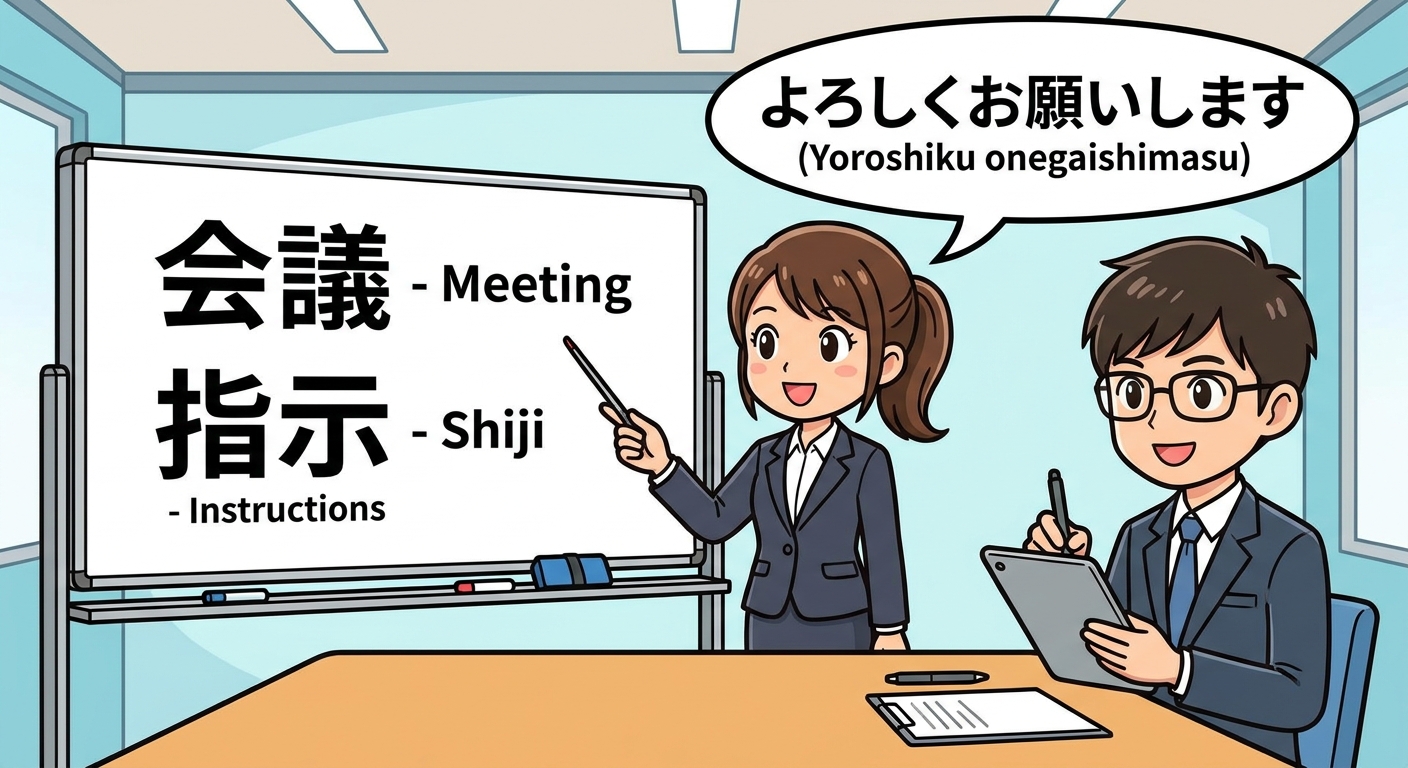
Introduction
In a Japanese corporate environment, meetings and instructions require more than just basic language skills; they demand an understanding of business etiquette, indirect expressions, and hierarchical nuances. This lesson is designed for N2-level learners who wish to navigate workplace discussions smoothly. You will learn how to comprehend complex directives from superiors, politely clarify ambiguous points, and present your opinions constructively during meetings. By mastering formal honorifics (keigo) and professional vocabulary specific to project management and decision-making, you will build the confidence needed to contribute actively and professionally to any Japanese business setting.
Lesson Content
Master Class: Workplace Meetings and Instructions (JLPT N2)
Navigating Japanese business meetings requires more than just polite Keigo (honorific language). At the JLPT N2 level, you must master the art of indirectness, precise progress reporting, and diplomatic boundary-setting.
This guide covers essential vocabulary, key N2 grammar patterns for meetings, and professional nuances that will make you sound like an elite corporate professional.
1. High-Frequency Meeting Vocabulary
| Japanese | Reading | English Meaning | Nuance / Usage |
|---|---|---|---|
| 議題 | ぎだい | Agenda / Discussion topic | Used to introduce the meeting's focus. |
| 進捗状況 | しんちょくじょうきょう | Progress status | Crucial for project updates. |
| 共有 | きょうゆう | Sharing (info/files) | Information sharing (情報共有) is a daily workplace buzzword. |
| 差し支えなければ | さしつかえなければ | If it is acceptable / If you don't mind | The ultimate polite cushion word for requests. |
2. Core N2 Grammar for Meetings & Instructions
To participate effectively in meetings, you must master these three N2 grammar structures used for scheduling, reporting progress, and polite refusals.
① 〜次第 (しだい) — As soon as...
- Grammar Rule:
Verb (Masu-stem) + 次第 - Meaning: "As soon as [Action A] is complete, [Action B] will immediately happen." This shows high professional urgency and reliability.
例文 (Example):
会議の資料ができ次第、メンバーに共有いたします。
Kaigi no shiryō ga deki-shidai, menbā ni kyōyū itashimasu.
(As soon as the meeting materials are ready, I will share them with the team.)
② 〜つつある — In the process of...
- Grammar Rule:
Verb (Masu-stem) + つつある - Meaning: "To be in the process of doing..." Used in status reports to show that a change or action is steadily progressing.
例文 (Example):
新規プロジェクトの準備は、現在進みつつあります。
Shinki purojekuto no junbi wa, genzai susumi-tsutsu arimasu.
(Preparations for the new project are currently underway/progressing.)
③ 〜かねる — Cannot / Unable to (Polite Refusal)
- Grammar Rule:
Verb (Masu-stem) + かねる - Meaning: "Cannot do." Even if you want to help, due to rules, safety, or circumstances, it is impossible. This is much more professional than saying dekimasen (できません).
例文 (Example):
その件につきましては、私の一存では決めかねます。
Sono ken ni tsukimashite wa, watashi no ichizon de wa kime-kanemasu.
(Regarding that matter, I cannot decide on my own authority.)
3. Workplace Dialogue: The Progress Update
Observe how these grammar points flow naturally in a standard N2-level meeting between Tanaka (Manager) and Sato (Staff).
- 田中部長 (Tanaka): 佐藤さん、例のA社との進捗状況はどうですか?
(Sato-san, how is the progress with Company A?) - 佐藤 (Sato): はい、現在条件を調整しつつありますが、先方の予算が厳しく、この条件では合意しかねるとのことです。
(Yes, we are currently in the process of adjusting the terms, but their budget is tight, and they say they cannot agree to these conditions.) - 田中部長 (Tanaka): なるほど。では、新しい提案書を作成して再交渉してください。
(I see. In that case, please draft a new proposal and renegotiate.) - 佐藤 (Sato): 承知いたしました。新しい提案書がまとまり次第、部長にご報告いたします。
(Understood. As soon as the new proposal is finalized, I will report to you.)
4. Tutor's Pro-Tip: Softening Instructions
In Japanese business culture, giving direct orders (even to subordinates) can sound overly harsh. To soften instructions, replace imperative forms with 〜ていただけますと幸いです (I would be highly grateful if you could...).
- Harsh: 明日までに報告書を出してください。 (Submit the report by tomorrow.)
- Elite Professional: 恐れ入りますが、明日までに報告書を提出していただけますと幸いです。 (I would appreciate it if you could submit the report by tomorrow.)
Exercises
Workplace Meetings and Instructions (Exercises)
Exercises for Workplace Meetings and Instructions
Review the grammar and vocabulary, and try to fill in the blanks or write sentences based on the prompts.
Examples
今日の会議の議事録をまとめ次第、関係者に配布してください。
Kyō no kaigi no gijiroku o matome-shidai, kankeisha ni haifu shite kudasai.
Please distribute the minutes of today's meeting to the relevant parties as soon as they are compiled.
会議での決定に基づいて、今後のプロジェクトの計画を進めていきましょう。
Kaigi de no kettei ni motozuite, kongo no purojekuto no keikaku o susumete ikimashō.
Based on the decisions made at the meeting, let's proceed with the future project plans.
部長からの指示に関して疑問な点があれば、作業を始める前に確認しておいてください。
Buchō kara no shiji ni kanshite gimon na ten ga areba, sagyō o hajimeru mae ni kakunin shite oite kudasai.
If you have any doubts regarding the instructions from the department manager, please make sure to clarify them before starting the work.
Practice Drills
Lesson Materials
Vocabulary (5)
Grammar (3)
Kanji (0)
No kanji characters in this lesson.
Kana (0)
No kana characters in this lesson.