
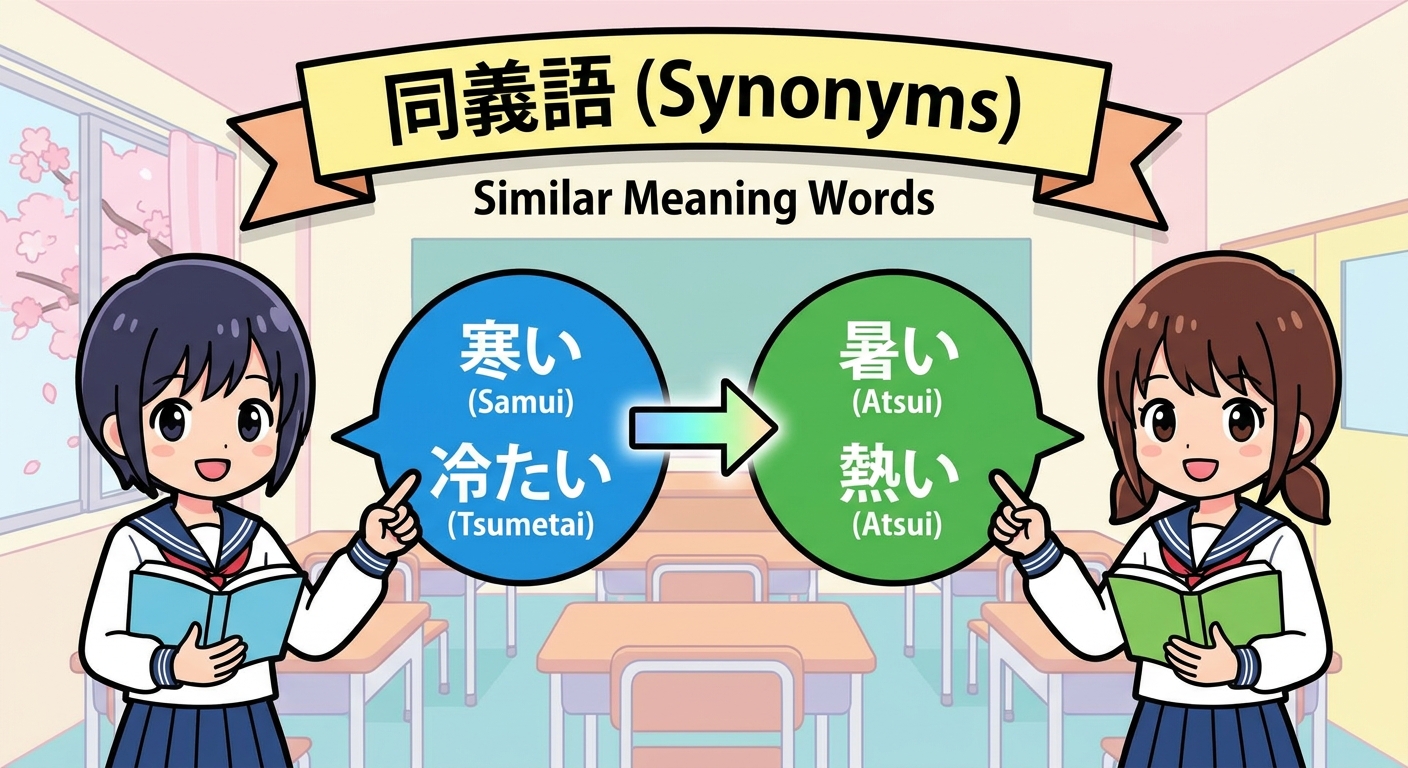
Similar Meaning Words (Synonyms)
Learn to distinguish between similar N2 vocabulary: 大切/重要/必要, 考える/思う/感じる. Master choosing the right word for each formal context.
🎯 Goal: To accurately identify, differentiate, and employ N2-level synonyms in context, enabling students to choose the most appropriate word based on formality, nuance, and collocation, thereby improving performance on the JLPT N2 vocabulary section and enhancing overall communicative precision.
Introduction
At the JLPT N2 level, mastering vocabulary is no longer just about memorizing individual words, but about understanding the precise nuances that distinguish similar terms (類義語). While many words translate to the same English equivalent, using them interchangeably can lead to unnatural or grammatically incorrect Japanese. This lesson focuses on demystifying N2-level synonyms by analyzing their specific contexts, collocations, and levels of formality. By examining how subtle differences in nuance affect usage in both written and spoken Japanese, you will transition from simply being understood to expressing yourself with the accuracy and sophistication of a native speaker.
Lesson Content
Master N2 Synonyms (類義語): Navigating Subtle Nuances
At the JLPT N2 level, vocabulary acquisition shifts from learning what a word means to understanding where and how to use it. Japanese is rich in synonyms (類義語 - ruigigo), and the exam frequently tests your ability to distinguish between words that translate similarly in English but carry distinct nuances, registers, or collocations.
In this guide, we will dissect two high-frequency synonym groups that confuse many N2 candidates.
Group 1: The Art of "Change" — 変更 vs. 修正 vs. 改正
While all three verbs mean "to change" or "to modify," they are not interchangeable. Using the wrong one can sound unnatural or completely change your intended meaning.
1. 変更 (へんこう - Henkō)
- Core Meaning: To change a pre-determined plan, schedule, or decision.
- Nuance: A shift from Option A to Option B. It does not imply that Option A was "wrong," just that it has changed.
- Common Collocation:
- 日程を変更する (To change the schedule)
- 仕様を変更する (To change the specifications)
2. 修正 (しゅうせい - Shūsei)
- Core Meaning: To correct, adjust, or touch up.
- Nuance: Implies fixing an error, improving a draft, or making a minor adjustment to align with reality.
- Common Collocation:
- 軌道を修正する (To correct one's course/orbit)
- 誤字を修正する (To correct a typo)
3. 改正 (かいせい - Kaisei)
- Core Meaning: To revise or amend (rules, laws, systems).
- Nuance: Changing a formal, public, or legal structure to make it better or more up-to-date.
- Common Collocation:
- 規則を改正する (To revise the rules)
- 憲法を改正する (To amend the constitution)
Group 2: Overcoming Obstacles — 克服する vs. 乗り越える
Both verbs mean "to overcome," but they paint different mental pictures.
       [OBSTACLE]
克服する:   (Inside)  --> Dissolves/Cures the weakness.
乗り越える: (Outside) --> physically or mentally climbs over the barrier.
1. 克服する (こくふくする - Kokufuku suru)
- Nuance: To conquer an internal weakness, illness, or fear. It is abstract and highly formal.
- Example:
- 弱点を克服して、試験に合格した。
- I overcame my weaknesses and passed the exam.
2. 乗り越える (のりこえる - Norikoeru)
- Nuance: To physically climb over an obstacle, or to endure and get past a difficult external situation (e.g., a crisis, grief).
- Example:
- 数々の困難を乗り越えて、会社を再建した。
- We overcame (climbed over) numerous hardships and rebuilt the company.
Quick Practice Challenge
Choose the correct word for each sentence:
- 法律が( 変更 / 改正 )され、消費税が上がった。
- 自分のデザインの悪い部分を( 修正 / 克服 )した。
Answers:
- 改正 (It is a formal law/system).
- 修正 (Correcting/adjusting a draft).
Tutor's Pro-Tip for N2 Success
When studying N2 synonyms, never memorize them in isolation. Always learn them with their target particles and nouns (collocations). Keep a dedicated "Nuance Journal" where you write down pair comparisons like the ones above. This is the key to scoring a perfect 60/60 on the Language Knowledge section!
Exercises
Similar Meaning Words (Synonyms) (Exercises)
Exercises for Similar Meaning Words (Synonyms)
Review the grammar and vocabulary, and try to fill in the blanks or write sentences based on the prompts.