
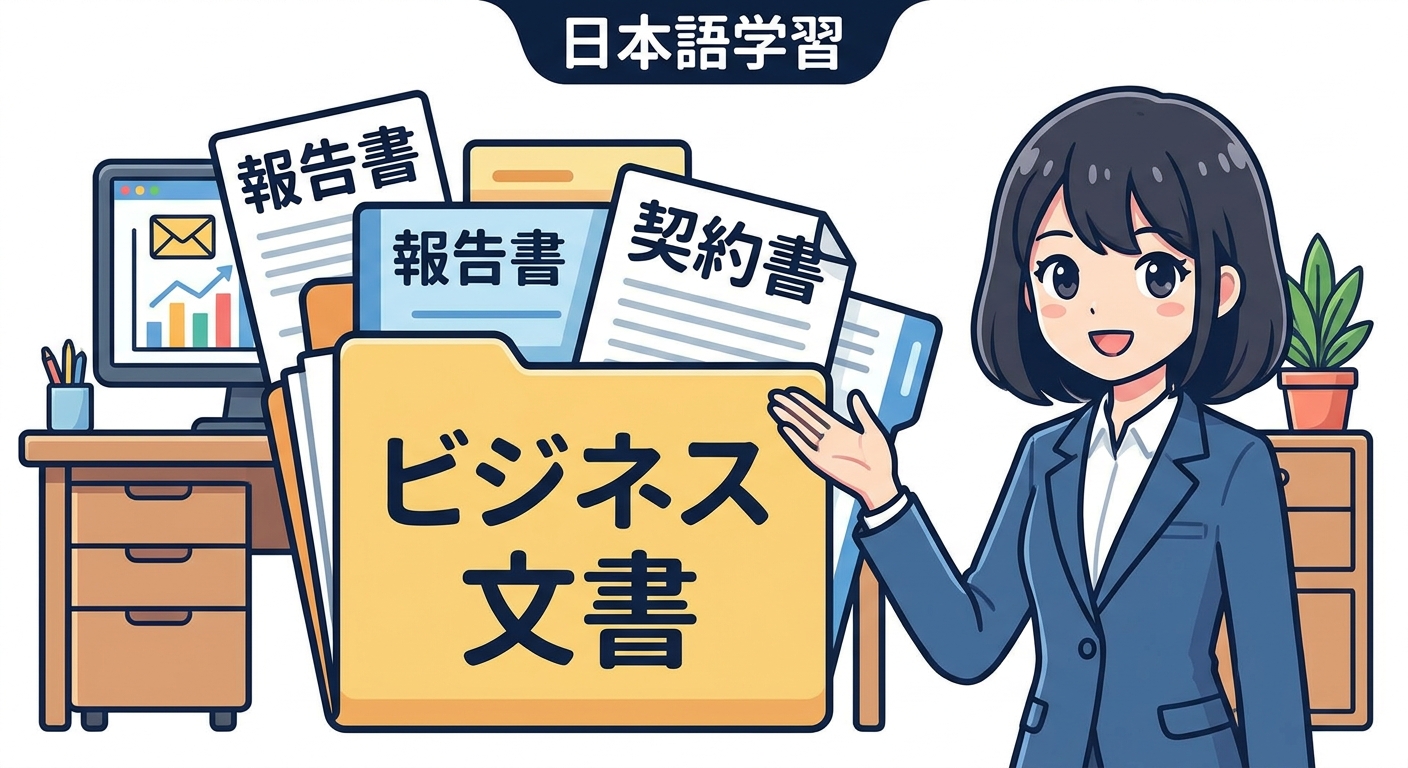
Business Documents
Read workplace notices, reports, and formal emails. Identify purpose, required action, deadline, and relevant parties.
🎯 Goal: To equip learners with the skills to accurately interpret and draft standard Japanese business documents—including emails, internal memos, and formal external letters—utilizing appropriate Keigo, professional formatting, and culturally respectful business etiquette at an N2 level.
Introduction
Welcome to the "Business Documents" lesson, tailored for JLPT N2 learners aiming to succeed in a professional Japanese environment. Mastering business correspondence is crucial for building trust with clients and colleagues. In this lesson, you will transition from general advanced Japanese to highly structured, formal business writing. We will explore the essential conventions of Japanese business documents, including standard formats for internal memos (shanai bunsho) and external letters (shagai bunsho). You will learn to navigate complex honorifics (Keigo), set expressions, and the subtle nuances required to communicate professionally, persuasively, and respectfully in any Japanese workplace.
Lesson Content
Master the Art of Japanese Business Documents (ビジネス文書の極意) — JLPT N2
In the Japanese professional world, writing is just as important as speaking. Business documents (ビジネス文書 - Bijinesu Bunsho), whether emails or formal letters, follow strict structural protocols and highly specialized grammar.
To pass the JLPT N2 and succeed in a Japanese office, you must master the delicate balance of Keigo (honorifics), standardized layouts, and polite euphemisms.
1. The Anatomy of an External Business Letter (社外文書)
External documents sent to clients or partners require a rigid, traditional structure. Missing these elements can make your correspondence seem unprofessional.
[拝啓 (Haikei) - Opening]
       ↓
[時候の挨拶 (Jikou no Aisatsu) - Seasonal Greeting]
       ↓
[本題 (Hondai) - Main Body]
       ↓
[結びの挨拶 (Musubi no Aisatsu) - Closing Greeting]
       ↓
[敬具 (Keigu) - Closing]
Key Components:
- 拝啓 (Haikei) & 敬具 (Keigu): These are a non-negotiable pair. Haikei means "Dear Sir/Madam," and Keigu means "Sincerely yours." If you start with Haikei, you must end with Keigu.
- 時候の挨拶 (Jikou no Aisatsu): A seasonal greeting showing awareness of nature and the recipient's well-being.
- Example: 貴社におかれましては、ますますご清栄のこととお慶び申し上げます。
(We rejoice that your company is increasingly prosperous.)
- Example: 貴社におかれましては、ますますご清栄のこととお慶び申し上げます。
2. High-Yield N2 Grammar for Business Writing
To soften your tone and project utmost professionalism, replace direct N3 grammar with these N2 patterns.
A. 〜かねます (Polite Refusal)
In Japanese business, saying "No" (できません) is considered too blunt. Instead, use the N2 grammar [Verb Stem + かねます] to express a polite inability to do something.
- Structure: 動詞ます形(stem) + かねます
- Example:
- 弊社ではその条件はお引き受けかねます。
- Translation: We are afraid we cannot accept those conditions.
B. 〜次第 (As Soon As...)
In business, promptness is key. Use [Verb Stem + 次第 (しだい)] to indicate that you will perform an action immediately after something else is completed.
- Structure: 動詞ます形(stem) + 次第
- Example:
- 日程が決まり次第、ご連絡いたします。
- Translation: As soon as the schedule is decided, I will contact you.
C. 〜の件 (Regarding...)
Used constantly in email subject lines and introductions to establish the topic quickly.
- Structure: [Noun] + の件
- Example:
- 新規プロジェクトの件について、ご相談がございます。
- Translation: I would like to consult with you regarding the new project.
3. Essential Written Keigo Vocabulary
Written business Japanese uses specific vocabulary (Kango) that differs from daily spoken Japanese.
| Spoken/Casual | Written Business Equivalent | English Meaning |
|---|---|---|
| 送る (Okuru) | ご送付いたします (Go-sōfu itashimasu) | I will send |
| 見る (Miru) | ご査収ください (Go-sashū kudasai) | Please inspect/check |
| もらう (Morau) | 受領いたしました (Juryō itashimashita) | I have received |
| あとで (Ato de) | 後日 (Gojitsu) | At a later date |
4. Real-World Application: Sample Email Template
Here is a standard, professional N2-level email sent to a client. Notice how the grammar and vocabulary discussed above tie together seamlessly.
Subject: 【ご提案】新規プロジェクト資料の件 (Proposal: Regarding the New Project Materials)
〇〇株式会社
営業部 佐藤様
いつも大変お世話になっております。
△△株式会社の鈴木でございます。
先ほどお電話にてお話しいたしました、新規プロジェクトの企画書をご送付いたします。
ご多忙中恐れ入りますが、ご査収のほどよろしくお願い申し上げます。
なお、内容についてご不明な点がございましたら、私までお気軽にお問い合わせください。
スケジュールの詳細が分かり次第、改めてご連絡申し上げます。
それでは、ご検討のほどよろしくお願いいたします。
[署名 (Your Signature Block)]
Tutor's Pro-Tip for Success 💡
When writing business documents in Japanese, less is not more; politeness is more. Always opt for humble forms (Kenjougo) when referring to your own actions (e.g., 送付いたします) and respectful forms (Sonkeigo) when referring to your client's actions (e.g., ご査収ください). Master these patterns, and you will ace both your N2 exam and your future Japanese career!
Exercises
Business Documents (Exercises)
Exercises for Business Documents
Review the grammar and vocabulary, and try to fill in the blanks or write sentences based on the prompts.
Examples
本メールに契約書の写しを添付いたしましたので、ご査収のほどよろしくお願い申し上げます。
Hon mēru ni keiyakusho no utsushi o tenpu itashimashita node, goshashū no hodo yoroshiku onegai mōshiaagemasu.
I have attached a copy of the contract to this email, so please kindly review it.
諸般の事情により、新規プロジェクトの開始時期を延期せざるを得なくなりました。
Shohan no jijō ni yori, shinki purojekto no kaishi jiki o enki sezaru o enakunarima shita.
Due to various circumstances, we have no choice but to postpone the start date of the new project.
お見積書の内容をご確認の上、来週の金曜日までに折り返しご連絡いただけますと幸いです。
Omitsumorisho no naiyō o gokakunin no ue, raishū no kin'yōbi made ni orikaeshi gorenraku itadakemasu to saiwaidesu.
We would appreciate it if you could review the details of the estimate and get back to us by next Friday.
Practice Drills
Lesson Materials
Vocabulary (5)
Grammar (3)
Kanji (0)
No kanji characters in this lesson.
Kana (0)
No kana characters in this lesson.