
Building Japanese with Avnish as a Learner
Introduction
Embarking on the journey to learn Japanese is a decision that opens doors to a rich culture, literature, and global communication. For many, the first formal milestone is the Japanese Language Proficiency Test (JLPT) N5. This blog is not just a guide; it is the story of why I built this platform—not as a language expert, but as the student I once was. I understand the struggles of self-study: the confusion of grammar particles, the overwhelming number of kanji, and the lack of a clear path. This platform is designed to be the structured, calm companion I wished I had. Whether you are in India or anywhere else, N5 is achievable with the right approach.
Table of Contents
- Understanding the JLPT N5 Exam Structure
- Why I Built This Platform: A Student's Perspective
- The Core of N5: Grammar, Vocabulary, and Kanji
- A Practical Study Schedule for Busy Learners
- Common Pitfalls and How to Avoid Them
- How This Platform Supports Your Journey
- Conclusion: Your Path to N5
Understanding the JLPT N5 Exam Structure
The JLPT N5 exam is the entry-level test, assessing basic Japanese comprehension. It consists of three sections: Language Knowledge (Vocabulary and Grammar), Reading, and Listening. The total test time is approximately 105 minutes. Understanding this structure is the first step to targeted preparation.
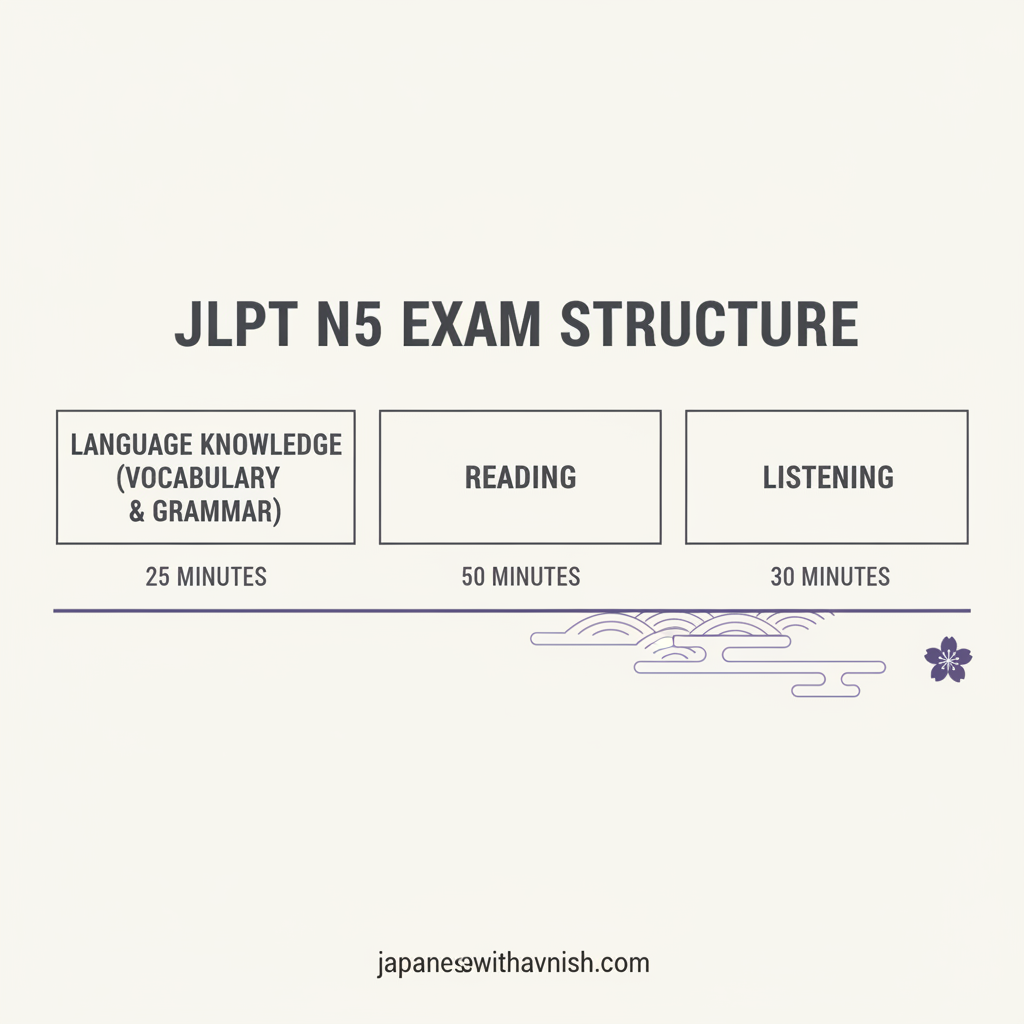
- Language Knowledge (Vocabulary & Grammar): 25 minutes. This section tests your knowledge of basic vocabulary (about 800 words) and fundamental grammar structures (around 80 patterns). You will encounter multiple-choice questions on particle usage, verb conjugation, and sentence structure.
- Reading: 20 minutes. This section includes short passages, notices, and simple dialogues. The focus is on understanding basic information, such as time, place, and simple instructions.
- Listening: 30 minutes. This section tests your ability to understand simple conversations and announcements. It includes questions with pictures and short dialogues.
To succeed, you need a clear understanding of each section's demands. For example, the listening section often uses everyday situations like shopping or asking for directions.
Why I Built This Platform: A Student's Perspective
When I started learning Japanese, I was a student with a passion but no roadmap. I bought textbooks, downloaded apps, and watched countless videos. But I often felt lost. There was too much information, and not enough structure. I built this platform to fill that gap. It is designed from the perspective of a learner, not an expert. Every lesson is crafted to answer the questions I had: "Why is this particle used here?" or "How do I remember this kanji?" The content is not just academic; it is empathetic. It acknowledges that learning a language is a gradual process, and every small step counts. This platform is my gift to fellow learners—a system that is calm, structured, and focused on your success.
The Core of N5: Grammar, Vocabulary, and Kanji
The N5 level covers the building blocks of Japanese. Let's break down the three core areas.
Grammar
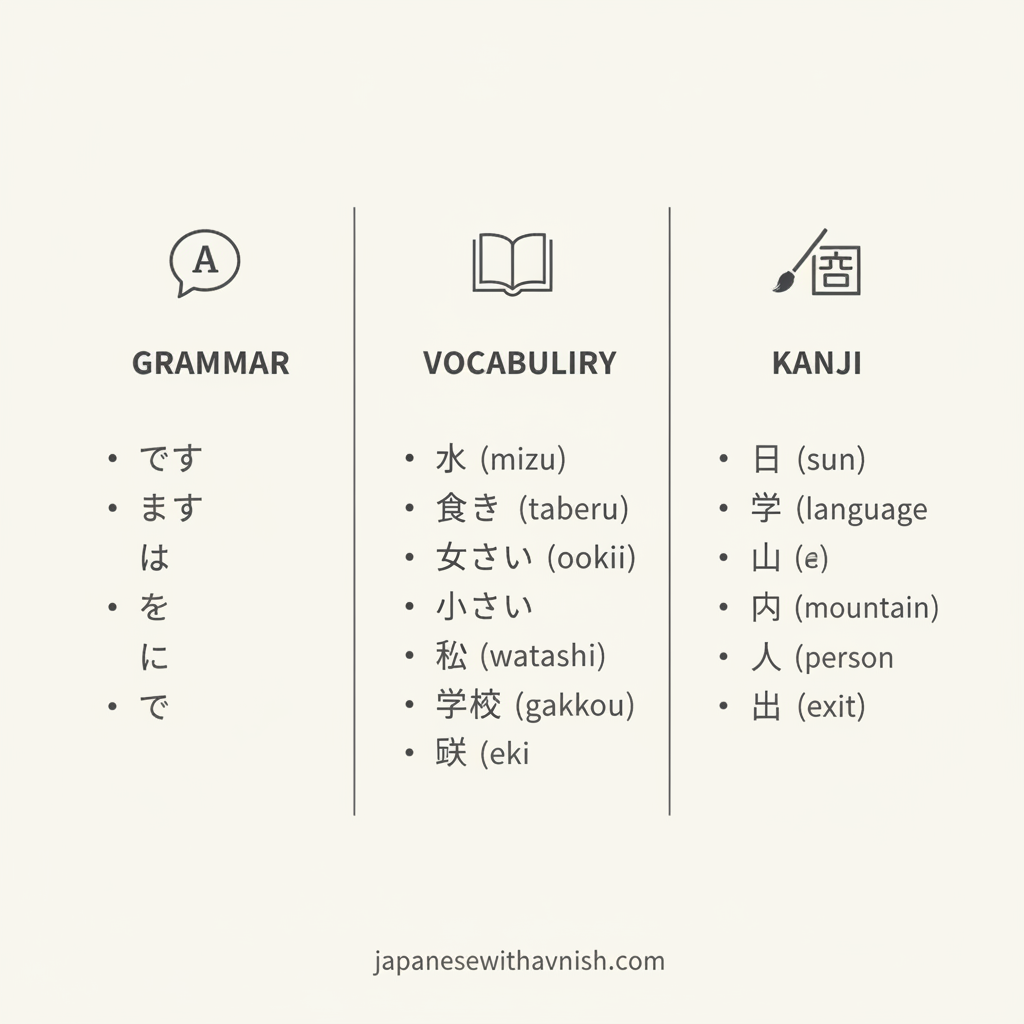
N5 grammar includes basic sentence structures: です (desu), ます (masu) verbs, particles (は, が, を, に, で, へ, と, から, まで), and question words. For example:
- 私は学生です。 (Watashi wa gakusei desu.) — I am a student.
- 毎日、日本語を勉強します。 (Mainichi, nihongo o benkyou shimasu.) — I study Japanese every day.
Vocabulary
You need about 800 words. These cover everyday topics: numbers, time, family, food, colors, and basic verbs. For instance:
- 水 (みず, mizu) — water
- 食べる (たべる, taberu) — to eat
- 大きい (おおきい, ookii) — big
Kanji
You need to know approximately 100 kanji. These are simple characters like:
- 日 (にち, nichi) — day, sun
- 人 (ひと, hito) — person
- 学 (がく, gaku) — study, learning
A structured approach to learning these elements is crucial. For example, group kanji by theme (e.g., time, nature) and practice with flashcards.
A Practical Study Schedule for Busy Learners
Consistency is key. Here is a sample weekly schedule for N5 preparation, assuming you have 30 minutes to 1 hour daily.
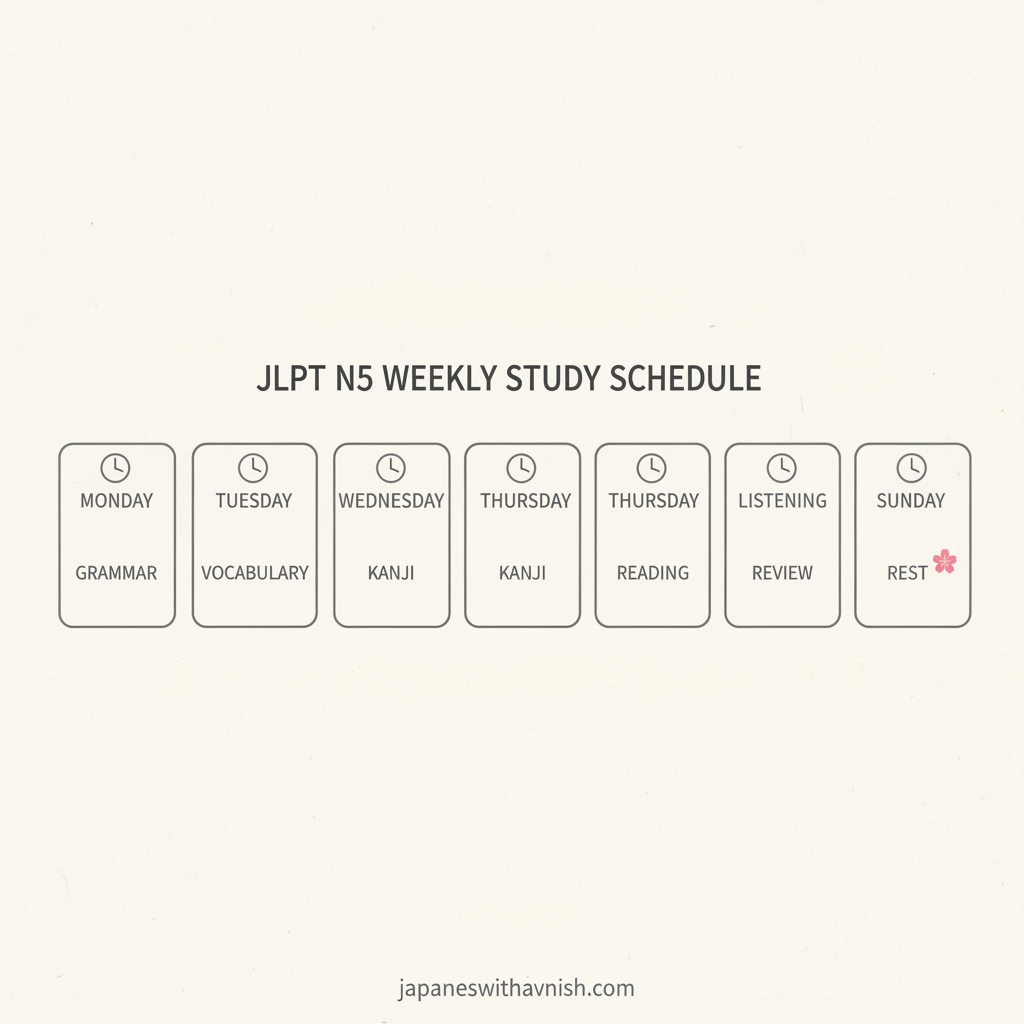
- Monday: Grammar (30 min) — Study one new grammar pattern and practice with 5 sentences.
- Tuesday: Vocabulary (30 min) — Learn 10 new words and review previous ones.
- Wednesday: Kanji (30 min) — Practice 5 new kanji and their readings.
- Thursday: Listening (30 min) — Listen to a short audio dialogue and answer questions.
- Friday: Reading (30 min) — Read a simple text (e.g., a short notice) and check comprehension.
- Saturday: Review (1 hour) — Go over the week's grammar, vocabulary, and kanji. Take a practice quiz.
- Sunday: Rest or light review (15 min) — Listen to Japanese music or watch a short video with subtitles.
This schedule is flexible. Adjust it to your pace. The goal is to build a habit, not to overwhelm yourself.
Common Pitfalls and How to Avoid Them
Many learners face similar challenges. Here are a few and how to overcome them.
Pitfall 1: Memorizing Without Context
You might memorize vocabulary lists but struggle to use them. Solution: Learn words in sentences. For example, instead of just memorizing "食べる (taberu)", learn "私は毎日パンを食べます (Watashi wa mainichi pan o tabemasu)" — I eat bread every day.
Pitfall 2: Ignoring Listening Practice
Reading and writing are easier to practice, but listening is crucial for the exam. Solution: Use audio resources. Listen to simple dialogues repeatedly. Shadow the speaker to improve pronunciation.
Pitfall 3: Rushing Through Kanji
Kanji can be intimidating. Solution: Focus on radicals and stroke order. Write them by hand. Use mnemonics: for example, 日 (sun) looks like a square with a line through it, representing the sun's rays.
Pitfall 4: Lack of Review
Forgetting is natural. Solution: Use spaced repetition. Review old material regularly. A simple notebook or digital tool can track what you've learned.
How This Platform Supports Your Journey
This platform is built with these pitfalls in mind. Every lesson is contextual. Grammar points are explained with real examples. Vocabulary is grouped by theme. Kanji are introduced with radicals and stories. Audio drills are included for listening practice. The structure is designed to guide you step by step, from the basics to exam readiness.
For a comprehensive system, consider our N5 Mastery Bundle. It includes grammar guides, vocabulary lists, kanji workbooks, practice tests, and audio exercises—all in one place.
Conclusion: Your Path to N5
Learning Japanese is a journey, and the JLPT N5 is your first milestone. With a structured approach, consistent practice, and the right resources, you can achieve this goal. Remember, I built this platform as a student—someone who knows the struggle. You are not alone. Take it one step at a time.
If you prefer a ready-made study system, explore our Complete Japanese N5-N1 Mega Bundle for a lifelong resource. Or, if you are focusing on N5, the N5 Mastery Bundle is designed for serious learners like you. Start today, and let this platform be your guide. Your N5 success is within reach.
Summary
Why I built this platform as the student I was, not as a language expert — and what that means for how it's made.
What should you do next?
Recommended next reads
My Journey from N5 Toward N3
A first-person account of going from zero Japanese to JLPT N3 — the real study rhythm, the plateaus, and what actually worked.
Avnish · 7/16/2026
Read →
Mistakes I Made While Learning Japanese
The study habits that quietly slowed my Japanese learning down for months, and what I changed instead.
Avnish · 7/16/2026
Read →
How I Study Kanji Every Day
My real daily kanji routine: radicals first, small daily batches, handwriting, and reviewing in context.
Avnish · 7/16/2026
Read →
Reasons to Learn Japanese: A Guide for JLPT N5
Discover compelling reasons to learn Japanese, tailored for JLPT N5 aspirants. Explore cultural immersion, career benefits, and personal growth.
Japanese with Avnish Editorial Team · 7/14/2026
Read →
Best Books for JLPT N5: A Structured Guide for Your Foundation
A structured guide to the best textbooks, kanji, grammar, and practice books for JLPT N5. Build a solid foundation with our expert recommendations and study plan.
Japanese with Avnish Editorial Team · 3/3/2026
Read →
JLPT N5 Roadmap: Your Structured Guide to Success
A comprehensive, step-by-step guide to passing the JLPT N5. Covers exam structure, study plan, essential grammar, vocabulary, and kanji for beginners.
Japanese with Avnish Editorial Team · 3/3/2026
Read →