
Numbers + Time Kanji
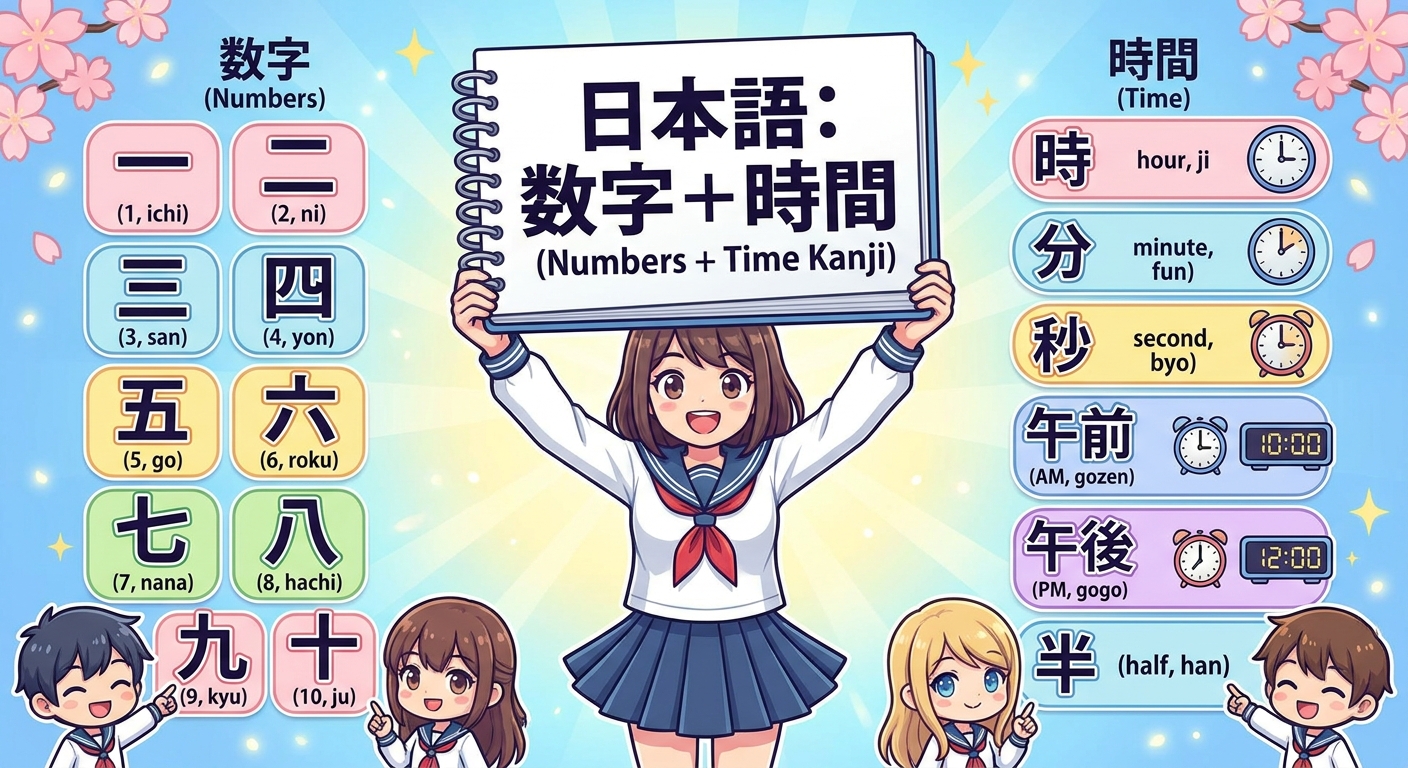
Learn 14 foundational kanji: 一二三四五六七八九十日月年時. Master on-yomi and kun-yomi readings and practice writing stroke order.
🎯 Goal: By the end of this lesson, you will be able to identify, write, and read the core JLPT N5 kanji for numbers 1–10 and time indicators (hour, minute, half), allowing you to tell time and read schedules in Japanese with confidence.
Introduction
Welcome to the "Numbers + Time Kanji" lesson, a foundational step in your JLPT N5 journey. Mastering how to read and write numbers and time-related kanji is essential for daily life in Japan, from reading train schedules to making appointments. In this lesson, we will demystify the essential kanji for numbers 1 through 10, along with key time indicators like hours (時) and minutes (分). By understanding the stroke orders, readings, and common combinations of these characters, you will build the confidence needed to navigate schedules, express times, and unlock practical communication skills in Japanese.
Lesson Content
Mastering the Clock: Japanese Numbers & Time Kanji (JLPT N5)
In Japanese, talking about time is one of the most practical skills you can master. It is also a major milestone for the JLPT N5 exam. This guide will walk you through the essential Kanji for numbers and time, explain crucial pronunciation irregularities, and show you how to build complete sentences using time particles.
1. The Core Kanji: Numbers & Time
To tell time, you must first master the Kanji for numbers 1 to 10, along with the two primary time markers: 時 (hour/o'clock) and 分 (minute).
| Kanji | Stroke Count | On-Yomi (Sino-Japanese) | Kun-Yomi (Native) | Meaning |
|---|---|---|---|---|
| 一 | 1 | イチ (ichi) | ひと (hito) | One |
| 二 | 2 | ニ (ni) | ふた (futa) | Two |
| 三 | 3 | サン (san) | み (mi) | Three |
| 四 | 5 | シ (shi) / ヨン (yon) | よ (yo) | Four |
| 五 | 4 | ゴ (go) | いつ (itsu) | Five |
| 六 | 4 | ロク (roku) | む (mu) | Six |
| 七 | 2 | シチ (shichi) / ナナ (nana) | なな (nana) | Seven |
| 八 | 2 | ハチ (hachi) | や (ya) | Eight |
| 九 | 2 | キュウ (kyū) / ク (ku) | ここの (kokono) | Nine |
| 十 | 2 | ジュウ (jū) | とお (tō) | Ten |
| 時 | 10 | ジ (ji) | とき (toki) | Time / Hour |
| 分 | 4 | フン (fun) / プン (pun) | わ(かる) (wa-karu) | Minute / Part |
Stroke Order Tip:
- 時 (Hour): Write the left radical first (日 - sun, 4 strokes), followed by the right radical (寺 - temple, 6 strokes).
- 分 (Minute): Write the top "eight" shape (八) first, followed by the "knife" radical (刀) underneath.
2. Telling the Hour: 〜時 (じ - ji)
To express o'clock, attach 時 (じ) to the number. While most numbers behave normally, three hours are highly irregular and are heavily tested on the JLPT:
- 4 o'clock: 四時 $\rightarrow$ よじ (yoji) — Never say "yon-ji" or "shi-ji"!
- 7 o'clock: 七時 $\rightarrow$ しちじ (shichiji) — Though "nana-ji" is sometimes heard in casual speech, "shichiji" is the standard exam form.
- 9 o'clock: 九時 $\rightarrow$ くじ (kuji) — Never say "kyū-ji"!
Quick Reference:
- 1:00 = 一時 (いちじ)
- 2:00 = 二時 (にじ)
- 3:00 = 三時 (さんじ)
- 4:00 = 四時 (よじ) ⚠️
- 5:00 = 五時 (ごじ)
- 6:00 = 六時 (ろくじ)
- 7:00 = 七時 (しちじ) ⚠️
- 8:00 = 八時 (はちじ)
- 9:00 = 九時 (くじ) ⚠️
- 10:00 = 十時 (じゅうじ)
3. Telling the Minutes: 〜分 (ふん/ぷん)
Minutes are trickier because the pronunciation of 分 changes between ふん (fun) and ぷん (pun) depending on the preceding number to make pronunciation smoother (euphony).
| Minutes | Kanji | Hiragana | Romaji |
|---|---|---|---|
| 1 min | 一分 | いっぷん | ippun |
| 2 min | 二分 | にふん | nifun |
| 3 min | 三分 | さんぷん | sanpun |
| 4 min | 四分 | よんぷん | yonpun |
| 5 min | 五分 | ごふん | gofun |
| 6 min | 六分 | ろっぷん | roppun |
| 7 min | 七分 | ななふん | nanafun |
| 8 min | 八分 | はっぷん | happun |
| 9 min | 九分 | きゅうふん | kyūfun |
| 10 min | 十分 | じゅっぷん | juppun (or jippun) |
- Half-hour (30 mins): You can use 三十分 (さんじゅっぷん) or simply replace it with 半 (はん - han), meaning "half".
- Example: 2:30 $\rightarrow$ 二時半 (にじはん - niji-han).
4. Grammar: Putting Time in a Sentence
To specify the time at which an action occurs, use the time destination particle に (ni) (equivalent to "at" in English).
Sentence Pattern:
[Time] に [Verb]
(Action) at (Time)
Examples:
-
私は午前六時に起きます。
- Watashi wa gozen roku-ji ni okimasu.
- I get up at 6:00 AM.
- (Note: 午前/ごぜん = AM, 午後/ごご = PM)
-
九時半に学校へ行きます。
- Ku-ji han ni gakkō e ikimasu.
- I go to school at 9:30.
-
会議は十時十五分から十一時までです。
- Kaigi wa jū-ji jūgo-fun kara jūichi-ji made desu.
- The meeting is from 10:15 to 11:00.
- (Note: から = from, まで = until)
5. Quick Challenge!
Can you translate this sentence into Japanese using Kanji?
"I study at 8:00 PM."
(Scroll down for the answer!)
Answer:
午後八時に勉強します。
(ごごはちじにべんきょうします / Gogo hachi-ji ni benkyō shimasu.)
Exercises
Numbers + Time Kanji (Exercises)
Exercises for Numbers + Time Kanji
Review the grammar and vocabulary, and try to fill in the blanks or write sentences based on the prompts.
Examples
私は毎朝七時に起きます。
Watashi wa maiasa shichiji ni okimasu.
I wake up at 7 o'clock every morning.
毎日二時間日本語を勉強します。
Mainichi nijikan nihongo o benkyou shimasu.
I study Japanese for two hours every day.
今は三時半です。
Ima wa sanjihan desu.
It is 3:30 now.
Practice Drills
Lesson Materials
Vocabulary (5)
Grammar (3)
Kanji (8)
Kana (0)
No kana characters in this lesson.