
この・その・あの
Learn how demonstrative adjectives この, その, あの attach directly to nouns to mean 'this/that + noun'. Distinguish between pronoun and adjective demonstratives.
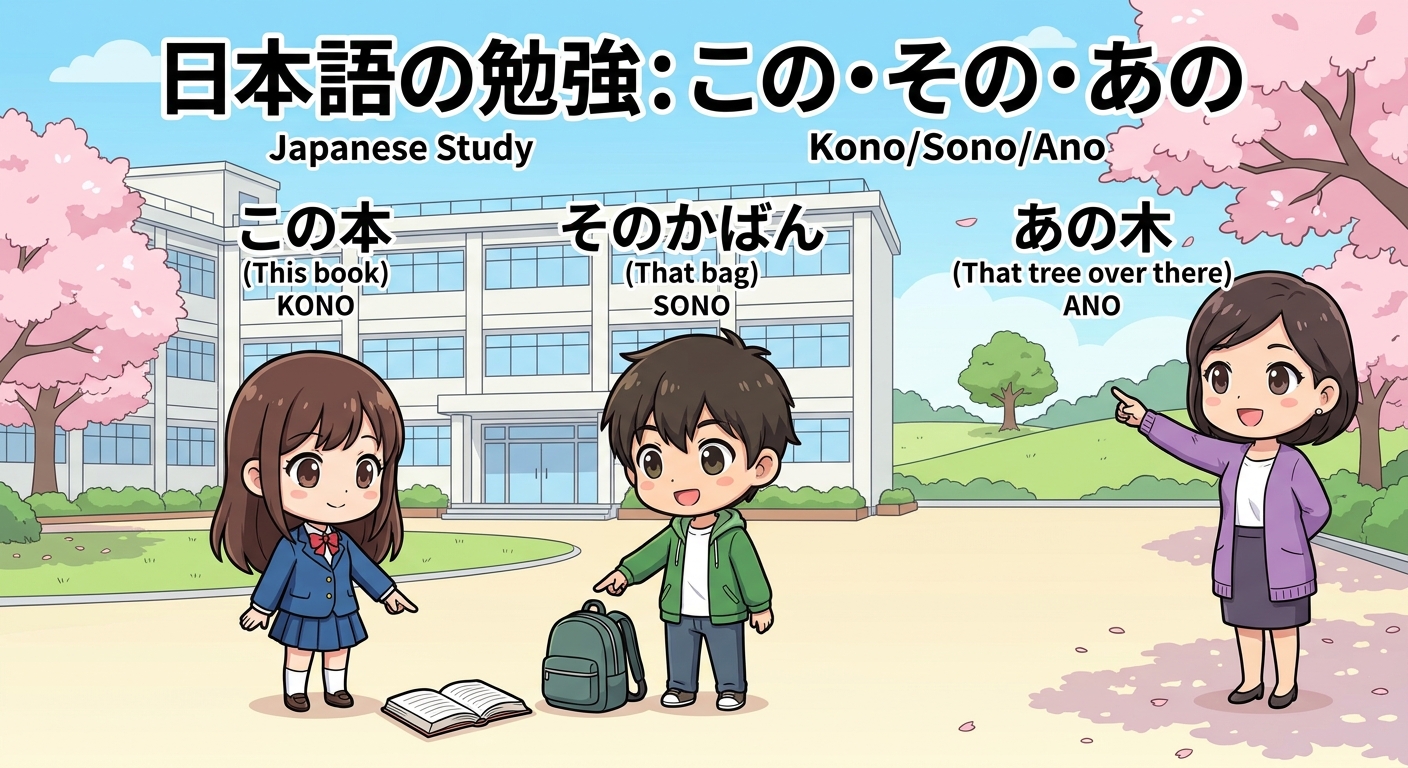
🎯 Goal: By the end of this lesson, you will be able to confidently identify and use "kono," "sono," and "ano" to point out and describe specific objects in relation to your and your listener's physical location in real-life scenarios.
Introduction
Welcome to your first step in mastering Japanese spatial awareness! In this lesson, you will learn the essential demonstrative determiners "kono" (this), "sono" (that), and "ano" (that over there). Unlike English, Japanese categorizes physical space into three distinct zones based on the relative proximity to both the speaker and the listener. Mastering these words is crucial for pointing out objects, describing your immediate surroundings, and engaging in natural, everyday conversations. By understanding how distance shapes Japanese communication, you will build a strong foundation for describing the world around you with accuracy and confidence.
Lesson Content
Mastering N5 Particles: を, で, に, and へ
Welcome to your ultimate guide to mastering four of the most fundamental particles in Japanese: を (o), で (de), に (ni), and へ (e).
Think of particles as the "glue" of the Japanese language. Without them, nouns and verbs are just random words. With them, you can build clear, expressive sentences. Let’s break them down step-by-step!
1. を (o) — The Direct Object Marker
The particle を acts like a pointing finger. It tells the listener exactly what is receiving the action of the verb.
$$\text{[Noun]} + \text{を} + \text{[Transitive Verb]}$$
- りんごを 食べます。
- Ringo o tabemasu.
- I eat an apple. (The apple is receiving the action of eating).
- 日本語を 勉強します。
- Nihongo o benkyou shimasu.
- I study Japanese.
💡 Tutor Tip: Pronounce を simply as "o" (the "w" is silent in modern Japanese).
2. で (de) — The "How" and "Where" Particle
で has two main jobs at the N5 level: marking the location of an action and marking the means or tool used to do something.
A. Location of Action (Where you do something)
- 図書館で 本を 読みます。
- Toshokan de hon o yomimasu.
- I read a book at the library.
B. Means, Tool, or Method (How you do something)
- はしで 寿司を 食べます。
- Hashi de sushi o tabemasu.
- I eat sushi with chopsticks.
- 車で 行きます。
- Kuruma de ikimasu.
- I will go by car.
3. に (ni) — The Target & Time Particle
に is highly versatile. At the N5 level, focus on its three primary roles: destination, static location, and specific time.
A. Destination of Movement (Where you are going)
- 日本に 行きます。
- Nihon ni ikimasu.
- I am going to Japan.
B. Static Location (Where something exists - used with あります/います)
- 部屋に 猫が います。
- Heya ni neko ga imasu.
- There is a cat in the room.
C. Specific Time (When something happens)
- 七時に 起きます。
- Shichiji ni okimasu.
- I wake up at 7 o'clock.
4. へ (e) — The Directional Arrow
へ (pronounced "e") is very similar to に when indicating movement. However, while に focuses on the destination (the arrival point), へ focuses on the direction (the journey towards it).
$$\text{[Noun (Place)]} + \text{へ} + \text{[Verb of Motion (行きます/来ます/帰ります)]}$$
- 京都へ 行きます。
- Kyouto e ikimasu.
- I am heading towards Kyoto.
💡 Tutor Tip: You can almost always replace へ with に, but you cannot always replace に with へ (e.g., you cannot use へ for time or static existence).
Quick Reference Summary
| Particle | Primary Function | English Equivalent | Example |
|---|---|---|---|
| を | Direct Object | (none) | 水を飲む (Drink water) |
| で | Location of action / Means | At, In / By, With | カフェで / バスで (At a cafe / By bus) |
| に | Destination / Existence / Time | To / In, At / At, On | 学校に行く / 3時に (Go to school / At 3:00) |
| へ | Direction of movement | Towards | 日本へようこそ (Welcome to Japan) |
Practice Challenge!
Fill in the blanks with the correct particle (を, で, に, へ). Answers below.
- 毎日、六時 ( __ ) 起きます。 (I wake up at 6:00 every day.)
- レストラン ( __ ) ピザ ( __ ) 食べました。 (I ate pizza at a restaurant.)
- 東京 ( __ ) 行きます。 (I am going to/towards Tokyo. Note: Two possible answers!)
Answers: 1. に (Specific time) | 2. で (Location of action), を (Direct object) | 3. に or へ (Destination/Direction)
Exercises
を / で / に / へ (Exercises)
Exercises for を / で / に / へ
Review the grammar and vocabulary, and try to fill in the blanks or write sentences based on the prompts.
Examples
この本は私のです。
Kono hon wa watashi no desu.
This book is mine.
その傘はあなたのですか。
Sono kasa wa anata no desu ka.
Is that umbrella yours?
あのカメラは高いです。
Ano kamera wa takai desu.
That camera over there is expensive.
Practice Drills
Lesson Materials
Vocabulary (5)
Kanji (0)
No kanji characters in this lesson.
Kana (0)
No kana characters in this lesson.