
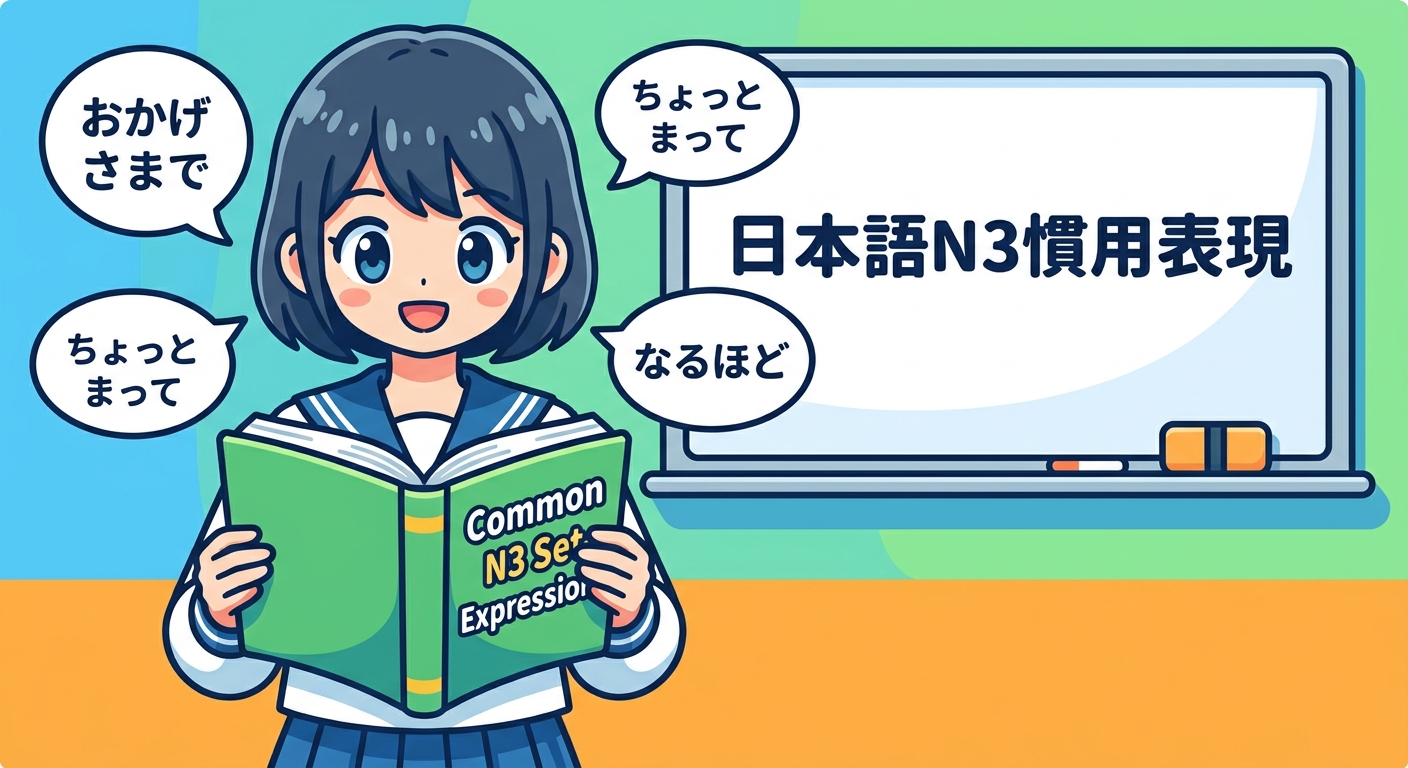
Common N3 Set Expressions
Learn 20 set expressions used in real N3 conversation: それに、ところが、しかし、それでも、やはり. Understand discourse markers and connectors.
🎯 Goal: To master high-frequency N3 set expressions and collocations, enabling you to recognize them instantly in reading and listening contexts, and to employ them accurately in speech and writing to sound more like a native Japanese speaker.
Introduction
Transitioning to the JLPT N3 level requires moving beyond basic grammar rules and embracing natural Japanese phrasing. This lesson focuses on "Common N3 Set Expressions" (定型表現), which are essential combinations of words that native speakers use instinctively. Mastering these collocations and idiomatic structures is key to improving both your reading comprehension and conversational fluency. By understanding how specific adverbs, particles, and verbs pair together naturally, you will bridge the gap between textbook Japanese and authentic communication, making your Japanese sound significantly more natural, cohesive, and precise.
Lesson Content
Master N3 Set Expressions: Bridging the Gap to Fluency
Welcome to your N3 masterclass. The JLPT N3 level is a major milestone: it is the bridge where textbook Japanese transforms into natural, conversational flow. To cross this bridge successfully, you must master Set Expressions (定型表現 - teikei hyōgen).
These are fixed grammatical patterns that native speakers use daily to convey nuance, obligation, and strong conviction. Today, we will dissect three essential N3 set expressions that will instantly elevate your reading comprehension and speaking naturalness.
1. 〜をきっかけに (wo kikkake ni)
"Triggered by..." / "With [X] as a start"
This expression is used when a specific event serves as the motivation or turning point for a subsequent, major action or change.
- Grammar Structure:
$$\text{Noun} + \text{をきっかけに / をきっかけにして}$$
(Note: If using a verb, nominalize it first using 〜たこと)
Example:
- 日本のアニメを見たことをきっかけに、日本語の勉強を始めました。
- Nihon no anime o mita koto o kikkake ni, nihongo no benkyō o hajimemashita.
- Translation: Triggered by watching Japanese anime, I started studying Japanese.
Tutor's Tip: Use this in job interviews or essay writing to explain your motivations. It sounds far more professional than simply using から (because).
2. 〜わけにはいかない (wake ni wa ikanai)
"Cannot afford to..." / "Must not (due to social/moral reasons)"
This is a powerful expression of social obligation. It means you physically could do something, but due to social norms, conscience, or common sense, you cannot afford to do it.
- Grammar Structure:
$$\text{Verb (Dictionary Form)} + \text{わけにはいかない}$$
Example:
- 明日は大事な試験があるので、今夜は遊ぶわけにはいかない。
- Ashita wa daiji na shiken ga aru node, konya wa asobu wake ni wa ikanai.
- Translation: Because I have an important exam tomorrow, I cannot afford to play tonight.
Nuance Check: Do not confuse this with the potential form (遊べない - asobenai). Asobenai implies physical impossibility. Asobu wake ni wa ikanai means you have the physical ability to play, but your conscience/responsibility prevents you from doing so.
3. 〜に違いない (ni chigainai)
"Must be..." / "Without a doubt"
When you are highly confident in your deduction based on evidence, use this expression. It conveys strong, subjective certainty.
- Grammar Structure:
$$\text{Verb / Adj (Plain Form)} + \text{に違いない}$$
$$\text{Noun / Na-Adj (No だ)} + \text{に違いない}$$
Example:
- 毎日遅くまで練習しているから、次の試合は彼らが勝つに違いない。
- Mainichi osoku made renshū shite iru kara, tsugi no shiai wa karera ga katsu ni chigainai.
- Translation: Since they practice late every day, they will undoubtedly win the next match.
Quick Reference Summary
| Set Expression | Meaning | Key Nuance |
|---|---|---|
| 〜をきっかけに | Triggered by... | Explains the catalyst for a life change. |
| 〜わけにはいかない | Cannot afford to... | Prevented by social duty or conscience. |
| 〜に違いない | Must be / No doubt | High confidence based on circumstantial evidence. |
Practice Challenge
Try translating this sentence into Japanese using today's grammar:
"Since I borrowed this book from my teacher, I must not lose it."
(Hint: Use 〜わけにはいかない for "must not lose").
Keep practicing, and watch your Japanese fluency soar!
Exercises
Common N3 Set Expressions (Exercises)
Exercises for Common N3 Set Expressions
Review the grammar and vocabulary, and try to fill in the blanks or write sentences based on the prompts.
Examples
日本には、富士山をはじめ、美しい山がたくさんあります。
Nihon ni wa, Fujisan o hajime, utsukushii yama ga takusan arimasu.
In Japan, there are many beautiful mountains, starting with Mount Fuji.
今年は去年に比べて、冬の寒さが厳しいです。
Kotoshi wa kyonen ni kurabete, fuyu no samusa ga kibishii desu.
Compared to last year, the winter cold is severe this year.
毎日一生懸命練習しているから、次の試合は勝てるに違いない。
Mainichi isshoukenmei renshuu shite iru kara, tsugi no shiai wa kateru ni chigainai.
Since they practice hard every day, they will surely win the next match.
Practice Drills
Lesson Materials
Vocabulary (5)
Grammar (3)
Kanji (0)
No kanji characters in this lesson.
Kana (0)
No kana characters in this lesson.