
Polite Requests and Apologies (丁寧な依頼 and 謝罪)
Master formal requests (〜ていただきたいのですが) and apologies (申し訳ございません, ご迷惑をおかけしました). Use in client-facing and hierarchical business contexts.
🎯 Goal: To confidently formulate sophisticated requests and formal apologies in business or academic settings, using appropriate N2-level honorifics and grammar patterns to maintain harmonious interpersonal relationships.
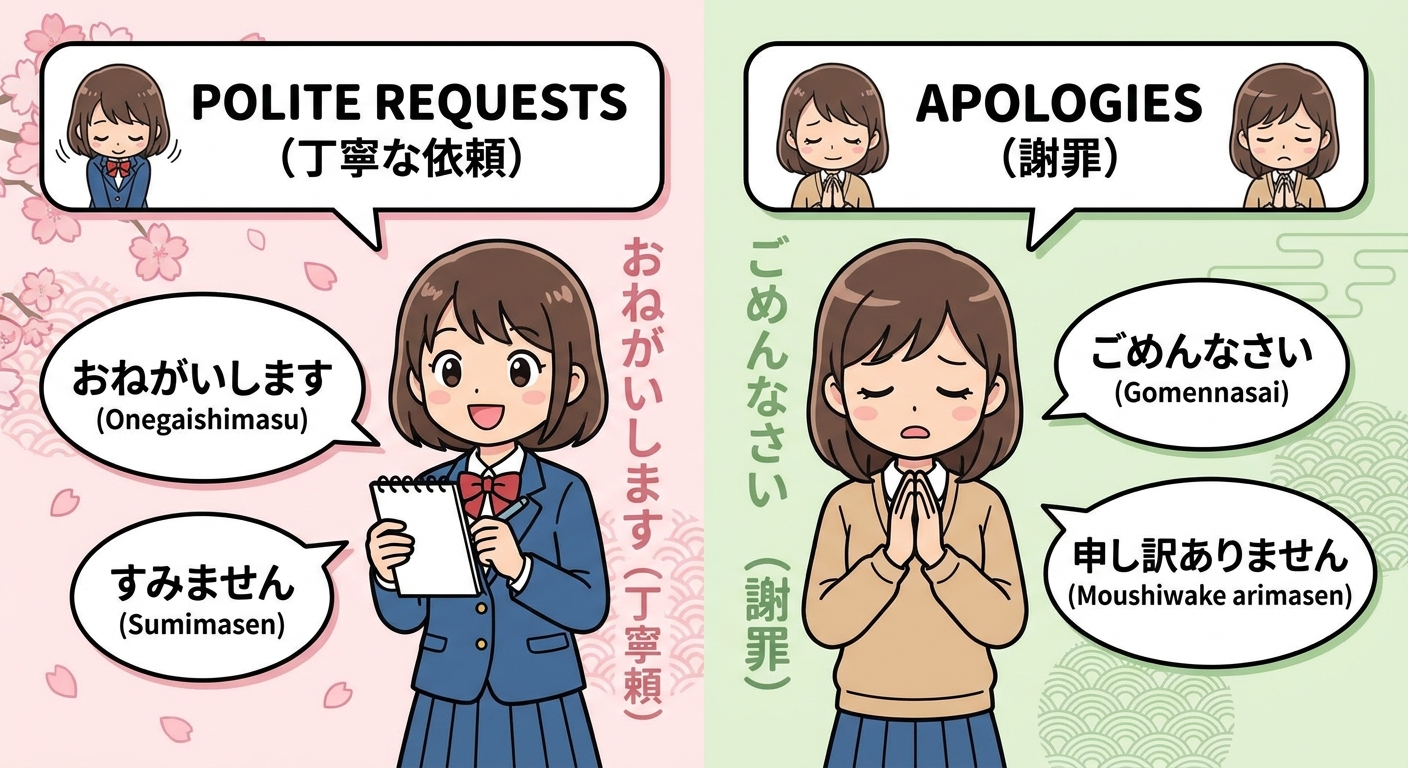
Introduction
Welcome to this lesson on N2-level polite requests and apologies. In professional and formal Japanese settings, mastering the delicate balance of respect and clarity is essential. This lesson focuses on advanced honorific structures (keigo) that allow you to make requests persuasively without imposing, and offer sincere apologies that restore trust. You will learn to navigate complex social distances using expressions like 〜ていただければ幸いです and 〜かねます. By understanding the subtle nuances behind these patterns, you will transition from basic politeness to natural, sophisticated business communication, ensuring your interactions remain harmonious and professional.
Lesson Content
Master Class: Polite Requests and Apologies (丁寧な依頼と謝罪) — JLPT N2
In professional and formal Japanese, communication is an art of mutual respect. At the JLPT N2 level, mastering requests (依頼 - いらい) and apologies (謝罪 - しゃざい) requires moving beyond basic textbook grammar into the realm of Keigo (honorifics) and indirect phrasing.
This guide will elevate your Japanese from "grammatically correct" to "culturally sophisticated."
1. Masterful Requests (丁寧な依頼)
To make a polite request at the N2 level, you must avoid sounding demanding. Instead of using 〜てください, use conditional and hypothetical structures to give the listener an "out," which paradoxically makes them more likely to help you.
Pattern A: 〜ていただければ幸いです (I would be grateful if you could...)
This is the gold standard for business emails. It expresses hope without imposing pressure.
- Structure:
Verb (て-form) + いただければ幸いです (さいわいです) - Example:
- 資料をご一読いただければ幸いです。
- Shiryou o go-ichidoku itadakereba saiwai desu.
- "I would be highly grateful if you could glance over the documents."
Pattern B: 〜お/ご〜願えますでしょうか (Could I possibly ask you to...?)
A humble request using the potential form of 願う (to pray/request).
- Structure:
お + Verb Stem / ご + Suru-Noun + 願えますでしょうか - Example:
- 恐れ入りますが、少々お時間をお取り願えますでしょうか。
- Osoreirimasu ga, shoujou o-jikan o o-tori negaemasu deshou ka.
- "I am sorry to bother you, but could I possibly ask for a moment of your time?"
2. Sincere Apologies (丁寧な謝罪)
An N2 apology requires taking full responsibility using humble language (Kenjougo).
Pattern A: 〜深くお詫び申し上げます (I offer my deepest apologies)
This is used for serious mistakes. お詫び申し上げます is the humble equivalent of "I apologize."
- Structure:
Noun + を深くお詫び申し上げます (ふかくおわびもうしあげます) - Example:
- 弊社の確認不足によりご迷惑をおかけしたことを、深くお詫び申し上げます。
- Heisha no kakunin-busoku ni yori go-meiwaku o okake shita koto o, fukaku owabi moushiagemasu.
- "We deeply apologize for causing you inconvenience due to our lack of verification."
Pattern B: 〜かねます (Unable to comply / Polite Refusal)
Sometimes, an apology involves saying "no." 〜かねます is an N2 grammar point used to politely refuse a request.
- Structure:
Verb Stem + かねます - Example:
- 私共ではその件に関してはお答えしかねます。申し訳ございません。
- Watashidomo de wa sono ken ni kanshite wa okotai shikanemasu. Moushiwake gozaimasen.
- "We are unable to answer regarding that matter. We apologize."
3. The Secret Weapon: Cushion Words (クッション言葉)
Before making a request or an apology, elite Japanese speakers use Cushion Words to soften the impact of their statement.
| Cushion Word | Romaji | Meaning | Best Used For... |
|---|---|---|---|
| 恐れ入りますが、 | Osoreirimasu ga... | "I am filled with trepidation, but..." | Introducing a request |
| お手数をおかけしますが、 | Otesu o okake shimasu ga... | "I am sorry to trouble you, but..." | Requesting an action/task |
| あいにくではございますが、 | Ainiku de wa gozaimasu ga... | "Unfortunately..." | Delivering bad news/refusal |
4. Practical Application: Business Email Scenario
Read how these elements come together in a real-world N2-level email.
Subject: 【重要】お打ち合わせ日程変更のお願い (Request to Change Meeting Date)
〇〇株式会社
鈴木様いつもお世話になっております。
大変恐縮ではございますが、急用のため、明日のお打ち合わせの日程を変更していただけないでしょうか。
こちらの不手際によりご迷惑をおかけしますことを、深くお詫び申し上げます。
来週の候補日をいくつか挙げておきますので、ご検討いただければ幸いです。
Tutor's Tip:
Notice how the email begins with a cushion word (大変恐縮ではございますが), moves to a polite request (〜いただけないでしょうか), offers a sincere apology (深くお詫び申し上げます), and ends with a soft request for future cooperation (〜いただければ幸いです). Mastering this flow is the key to passing the N2 listening and reading sections!
Exercises
Polite Requests and Apologies (丁寧な依頼 and 謝罪) (Exercises)
Exercises for Polite Requests and Apologies (丁寧な依頼 and 謝罪)
Review the grammar and vocabulary, and try to fill in the blanks or write sentences based on the prompts.
Examples
お忙しいところ恐縮ですが、こちらの資料をご一読いただけますでしょうか。
Oisogashii tokoro kyōshuku desu ga, kochira no shiryō o goichidoku itadakemasu deshō ka.
I am sorry to trouble you when you are busy, but could you please take a look at this document?
こちらの手違いにより、ご連絡が遅れましたことを深くお詫び申し上げます。
Kochira no techigai ni yori, gorenraku ga okureta koto o fukaku owabi mōshiagemasu.
We deeply apologize for the delay in contacting you due to an error on our part.
誠に勝手ながら、明日の会議は延期とさせていただきますので、何卒ご了承のほどお願い申し上げます。
Makoto ni katte nagara, asu no kaigi wa enki to sasete itadakimasu node, nanitozo goryōshō no hodo onegai mōshiagemasu.
Although it is very selfish of us, tomorrow's meeting will be postponed, so we kindly ask for your understanding.
Practice Drills
Lesson Materials
Vocabulary (0)
No vocabulary in this lesson.
Grammar (0)
No grammar rules in this lesson.
Kanji (0)
No kanji characters in this lesson.
Kana (0)
No kana characters in this lesson.