
Compare Two Texts
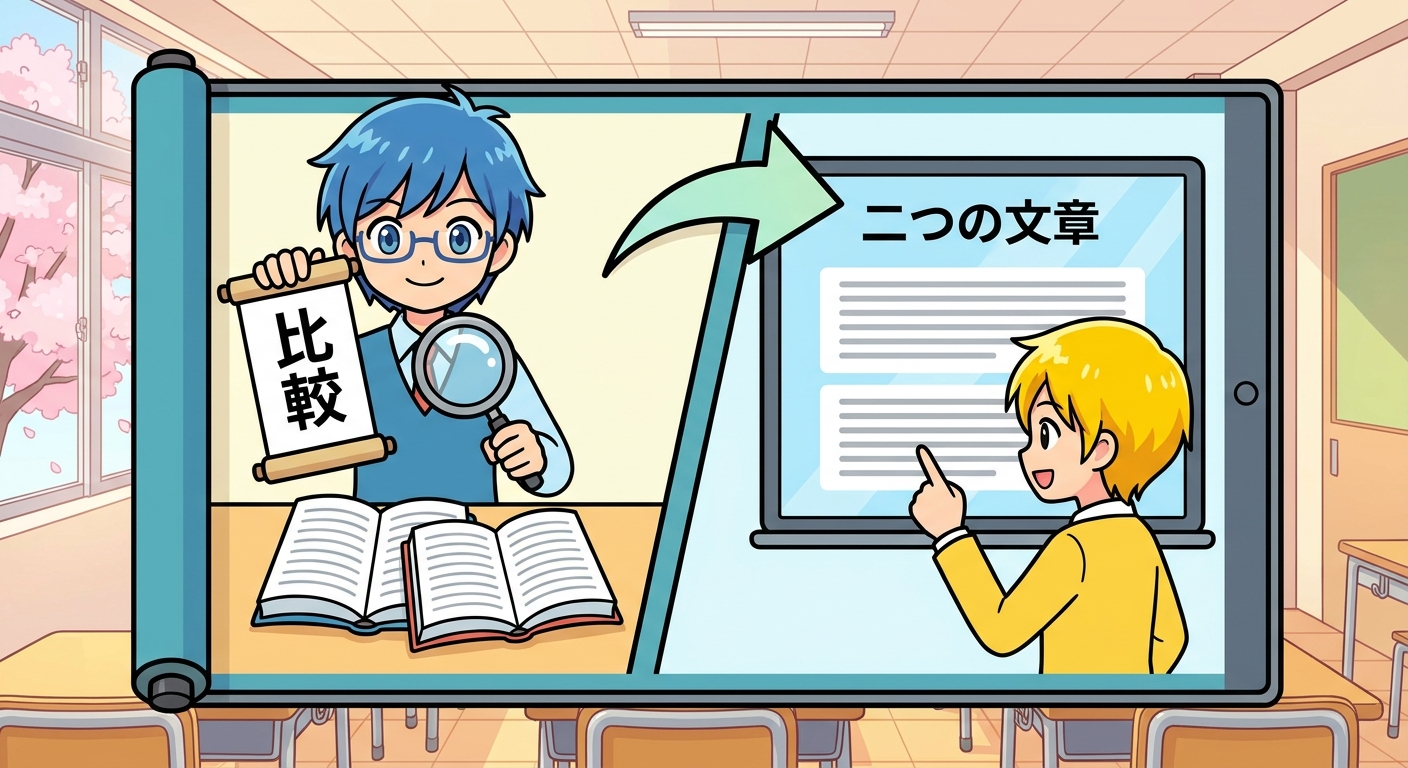
Read two short passages on the same topic from different perspectives. Identify where they agree, differ, and what each author emphasizes.
🎯 Goal: To successfully analyze and compare two Japanese texts on the same topic by identifying overlapping information, contrasting viewpoints, and the authors' underlying intentions, enabling you to accurately answer N2-level integrated comprehension questions within the recommended time limit.
Introduction
Welcome to the N2 reading comprehension lesson on comparing multiple texts. A key challenge of the JLPT N2 level is the 'Integrated Comprehension' (統合理解) section, where you must analyze two different texts on the same topic. This lesson is designed to sharpen your ability to quickly identify opposing viewpoints, shared perspectives, and subtle nuances in tone. You will learn systematic scanning techniques, how to map out contrasting arguments, and how to synthesize information efficiently under timed conditions. Mastering this skill will not only boost your exam score but also enhance your real-world Japanese academic and professional literacy.
Lesson Content
Master the JLPT N2: Comparing Two Texts (統合理解)
In the JLPT N2 Reading Section, one of the most challenging tasks is the Integrated Comprehension (統合理解 - Tōgō Rikai) question. You will be presented with two different texts (usually Text A and Text B) written by different authors on the same topic.
To ace this section, you must look beyond mere translation. You need to identify how the two authors’ viewpoints intersect, overlap, or clash.
1. The Three-Step Comparative Framework
When reading both texts, train your brain to answer these three questions instantly:
- 共通のテーマ (The Shared Theme): What is the overarching topic? (e.g., Remote work, environmental taxes, digital education).
- 共通点 (Points of Agreement): What do both authors agree on?
- 相違点 (Points of Divergence): Where do their opinions clash? (Look for differences in nuance, solutions, or ultimate conclusions).
2. Essential N2 Grammar for Comparison
Keep an eye out for these grammatical structures, as they often signal transitions, contrasts, or agreements between ideas:
| Grammar Point | Meaning | Usage in Comparison |
|---|---|---|
| ~に対して (ni taishite) | "In contrast to..." | Highlights a direct opposition between Text A and Text B. |
| ~一方で (ippō de) | "On one hand... / On the other hand..." | Used to present two sides of an issue. |
| ~と同様に (to dōyō ni) | "Just like..." / "In the same way as..." | Signals a point of agreement between the authors. |
| ~にすぎない (ni suginai) | "Nothing more than..." | Often used by one author to downplay an argument that the other author might value. |
3. Practice Passage: A Tale of Two Workstyles
Read the two short passages below and analyze how they compare.
Text A
近年、テレワークを導入する企業が急増している。通勤ストレスからの解放や、業務効率の向上など、そのメリットは計り知れない。確かに、社員間のコミュニケーション不足を懸念する声もあるが、それはオンラインツールを駆使することで十分に解決可能である。これからの時代、オフィスに縛られる働き方は衰退していくに違いない。
Text B
在宅勤務は、個人の作業効率を上げる上では非常に有効な手段である。しかし、新たなアイデアやイノベーションは、オフィスの雑談や偶然の対話から生まれることが多いのも事実だ。画面越しの意思疎通(オンラインツール)だけでは、深い信頼関係を築くのは難しい。企業の成長には、やはり対面での交流が不可欠だと言える。
4. Analytical Breakdown
Let's dissect these texts like an N2 examiner:
Step 1: Identify the Shared Theme
- Theme: テレワーク(在宅勤務)の是非とオフィスの価値 (The pros and cons of teleworking vs. the value of the office).
Step 2: Find the Agreement (共通点)
- Both authors agree that teleworking improves individual work efficiency (Text A: 業務効率の向上 / Text B: 個人の作業効率を上げる上では非常に有効).
Step 3: Find the Divergence (相違点)
- Text A's Stance: Communication issues can be fully solved using online tools. Physical offices are becoming obsolete.
- Text B's Stance: Online tools are insufficient for building deep trust or fostering innovation. Physical, face-to-face contact in the office is indispensable.
💡 Tutor's Pro-Tip for Exam Day
Do not read Text A and Text B in isolation. Read Text A first, and write a 3-word summary of the author's stance in the margin (e.g., "Pro-Telework"). As you read Text B, actively look for the sentence that directly responds to or refutes Text A's main argument. This will lead you directly to the correct answer!
Exercises
Compare Two Texts (Exercises)
Exercises for Compare Two Texts
Review the grammar and vocabulary, and try to fill in the blanks or write sentences based on the prompts.
Practice Drills
Lesson Materials
Vocabulary (5)
Grammar (3)
Kanji (0)
No kanji characters in this lesson.
Kana (0)
No kana characters in this lesson.